Last updated 2026-07-09
TL;DR
Most states set outdoor play minimums between 75 and 100 square feet per child, and every one of them requires a fence on all sides. The federal CCDF framework sets no single national number, so the floor is your state's floor. Inspectors measure actual usable square footage, not total yard size, so know your state's rule before you apply.
What is the minimum outdoor play space required for a licensed daycare?
There is no single federal number. The Child Care and Development Fund (CCDF) regulations, which govern federal childcare subsidy money, require states to set health and safety standards for outdoor play areas but leave the square-footage floor to each state [1]. The number you will see most often is 75 square feet of usable outdoor space per child, and it shows up in licensing rules across a large share of states.
Some states go higher. California sets 75 square feet per child for licensed child care centers [2]. Texas requires 80 [3]. The Head Start Program Performance Standards, which apply to federally funded Head Start programs, say outdoor play space for preschoolers "must contain a minimum of 75 square feet per child" using the space at one time [4]. That figure has anchored the policy conversation for years, even for programs that get no Head Start money.
Family child care homes are a different animal. Some states lower the bar, and some let the provider use a neighborhood park as a substitute under specific conditions. That substitution comes with strings every time: the park has to be within a defined walking distance, you need a written plan, and several states still want some outdoor area on or right next to your property. Read your family home rules separately from the center rules. They usually live in a different section of the licensing code.
The word that runs through every state rule is "usable." A yard with a 10-foot slope, a swimming pool, or a storage shed dropped in the middle does not count fully. Inspectors walk the space and exclude anything the age group you serve cannot safely reach.
Does the outdoor space requirement change based on the ages of children served?
Yes, and this trips up more providers than almost anything else outdoors. Infant and toddler programs face different requirements than preschool programs, and not always in the direction you would guess.
Some states require infants to have their own outdoor space, fenced off from older children, to prevent trampling injuries. Others just require a tighter supervision ratio during outdoor time and let infants share a larger common yard. If you run an infant daycare, pull your state licensing rules for that specific age band.
Head Start draws the line between infants and toddlers on one side and preschoolers on the other. The 75-square-foot figure applies to preschool-age children. Infant and toddler outdoor areas must be separated from the preschool play area [4]. The separation rule exists because of documented injury risk when very young children share equipment with four- and five-year-olds.
School-age programs attached to a center sometimes get more slack, because many states assume school-agers spend part of the day on school grounds. But if you run an after-school or summer program and those children are on your licensed premises all day, your full outdoor minimum usually applies to every child on the license at any given moment, not only the ones outside right now.
What are the fencing requirements for daycare outdoor play areas?
Every state with published licensing rules requires a fence. No exceptions. The variation is all in height and gate specifications.
The most common minimum for a licensed daycare center is 4 feet, though many states demand 5 or 6, especially if the property borders a road, water, or another hazard. California's Title 22 requires a fence or natural barrier of at least 4 feet for centers [2]. Some states require self-closing, self-latching gates with the latch mounted high enough that a child cannot reach it.
Abut a road, a pool, open water, or railroad tracks and you should expect more. Many states then require a 6-foot fence or a double gate. Inspectors do not treat this lightly. A gate that does not latch reliably is one of the most cited outdoor deficiencies in the country.
Family homes usually face the same fencing rules as centers, but some states carve out an exception for rural or large-lot properties with natural barriers like dense hedgerows or steep grades. Do not assume a natural barrier counts. Get it in writing from your licensor before the inspection.
What outdoor equipment and surface standards do states require?
Licensing rules almost universally ban pressure-treated wood containing arsenic (CCA-treated wood) in play structures, following the EPA's 2003 phase-out of that preservative for residential use [5]. Older structures get flagged.
Under-equipment surfacing is where the detail gets technical. The Consumer Product Safety Commission's Public Playground Safety Handbook recommends specific depths of loose-fill material (wood chips, engineered wood fiber, pea gravel) based on fall height, and many state rules adopt those recommendations by reference [6]. Equipment up to 6 feet high generally needs at least 9 inches of loose-fill surfacing or an equivalent unitary mat. This matters at inspection. An inspector may push a probe straight into your wood chips to check the depth.
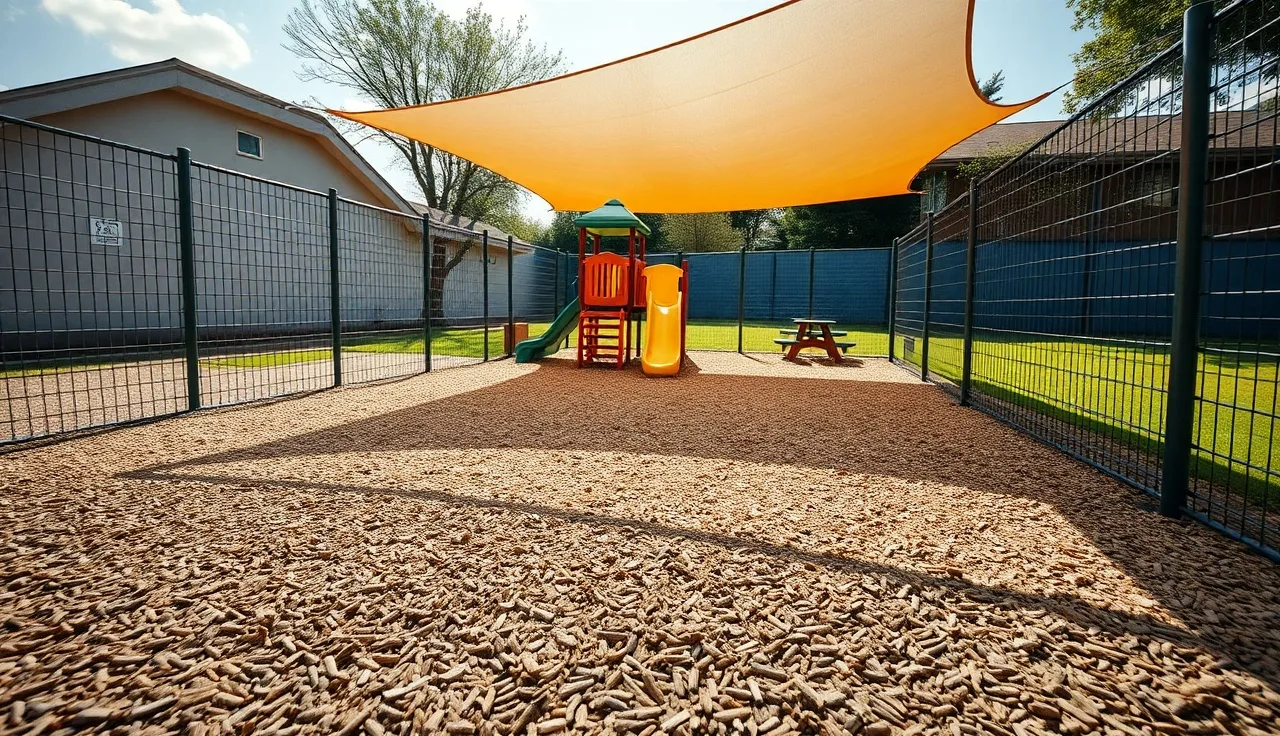
Shade is showing up in more rules every year. California, Arizona, Florida, and Texas, among others, require shading for part of the play area. Some rules set a percentage of the space that must be shaded, or require shade during the hottest hours. That can mean permanent structures, large trees with documented canopy, or portable shade sails.
Drinking water access is required in most states for outdoor play. The exact rule varies. Some want a water source at the play area itself, others just want children to have drinking water before and after outdoor time. Heat-illness prevention rules, which have expanded in several states since 2020, sometimes set water break frequency during outdoor play.
A good picture of what a daycare inspection covers outdoors helps you build a pre-inspection checklist.
How do inspectors actually measure and verify outdoor play space?
Inspectors do not eyeball the yard. They measure it. The standard method: calculate the total enclosed usable area in square feet, subtract the non-usable parts (the building footprint that pushes into the yard, permanent fixtures, unusable slopes, non-draining low spots), then divide by licensed capacity to see if you clear the per-child minimum.
The capacity used in that math is your maximum approved enrollment, not today's headcount. Licensed for 40 but only enrolling 25 right now? The inspector still calculates against 40. Worth knowing before you apply for a capacity increase.
Here is the concrete check. At 75 square feet per child and a target capacity of 40, you need at least 3,000 square feet of usable outdoor space. Want 60 children? That is 4,500 square feet. Plenty of urban providers find their backyard falls short the moment somebody measures it this way.
Photos do not satisfy this at inspection. Some states ask for a dimensioned site plan at the application stage, and the on-site inspector verifies those numbers in person. A gap between what you submitted and what gets measured can cost you capacity or earn you a deficiency citation.
Can a daycare use a shared or off-site space to meet outdoor requirements?
Some states allow it, but the conditions are strict and the paperwork is real.
The common case is a family child care home using a nearby public park. Typical requirements: written documentation that the park sits within a set walking distance (often a quarter mile or less), a written transportation and supervision plan, parent notification, and a finding that the park meets the state's equipment and surfacing standards. Some states want a signed agreement with the park authority.
For centers, shared outdoor space is much harder to get approved. If two programs share a yard, both programs' licensed capacities feed into the square-footage math. You cannot count the same 3,000 square feet twice unless scheduling documentation proves the groups never use the space at the same time, and even then some states say no.
A shared gym or indoor gross motor room is not a substitute for outdoor play in most states. Several states define "outdoor play space" as an area open to the sky or substantially open to outside air, so a covered but open-sided structure qualifies while an enclosed gym does not. Read the definitions section of your state's rules before you assume an indoor space covers you.
What are the specific outdoor space rules for home-based daycare providers?
Family child care homes sit in a different regulatory world than centers, and outdoor space is one of the clearest places you see the split.
Many states apply the same 75-square-foot-per-child standard to licensed family homes. Others reduce it. Some let providers count part of a front or side yard if it is enclosed. A few set a flat minimum (say, a fenced area of at least 500 or 600 total square feet for homes serving up to six children) instead of a per-child calculation. Your family home licensing rules govern here, not the center rules.
Fencing almost always applies to family homes. Providers who rent need written landlord permission for fence installation in many states, and licensing agencies will usually accept a permission letter for the file.
No usable yard at all? Most states will not license you for outdoor play without an approved alternative plan. A small number of urban home providers get licensed on a park substitution plan, but that takes documented proximity and a strong supervision plan. The ChildCareComp compliance toolkit includes state-by-state summaries of family home outdoor requirements, which saves time when the alternative is reading raw statute.
For more on what running a home-based program looks like day to day, the daycare center and daycares articles walk through the structural differences.
What federal rules and CCDF requirements govern outdoor play space?
The Child Care and Development Fund, run by the Office of Child Care inside HHS, is the main federal funding stream for childcare subsidies. The 2016 CCDF final rule expanded the health and safety requirements states must meet to receive CCDF money [1]. Outdoor play space is covered, but the rule sets a floor of process, not a floor of square footage.
45 CFR Part 98 requires states to have standards addressing health and safety in childcare settings that receive CCDF funds, and the 2016 rule lists physical activity and play space among the domains states must regulate [1]. The rule never says 75 square feet. It says states must have standards. What those standards say is up to each state.
The practical effect: every state, D.C., and territory holds a CCDF grant, so every one of them must have written outdoor play space rules on the books and apply them to licensed providers. A state whose rules go silent on outdoor space risks a finding in its federal CCDF review. That accountability loop is a big reason you see fairly consistent standards across the country even without a single federal number.
Child Care Aware of America publishes an annual report on childcare in the states that summarizes how state health and safety standards compare [7]. Their data shows real variation in outdoor minimums, but no state with an active CCDF grant has zero outdoor space requirement.
How do outdoor space requirements compare across states?
The table pulls from published state licensing regulations and Child Care Aware data. These figures are for licensed centers serving preschool-age children. Family home rules differ and may be lower.
| State | Outdoor sq ft per child (centers) | Fence height minimum | Notes |
|---|---|---|---|
| California | 75 | 4 ft | Title 22, Section 101239 |
| Texas | 80 | 4 ft | HHSC Child Care Licensing rules |
| Florida | 45 | Not specified in sq-ft rule | Must be enclosed |
| New York | 75 | 4 ft | OCFS regulations |
| Illinois | 75 | 4 ft | DCFS licensing standards |
| Pennsylvania | 75 | Not specified uniformly | Varies by county agency |
| Colorado | 75 | 4 ft | CDHS rules |
| Head Start (federal program) | 75 | N/A (site-specific) | 45 CFR 1302.31 |
Florida's lower number (45 sq ft) reflects a different approach to licensing density. Inspectors there lean harder on functional usability and shade than on raw square footage. Pennsylvania's county-administered system creates genuine variation inside one state, which catches people off guard when they move a program across county lines [8].
The 75-square-foot standard shows up most often, which is why Child Care Aware calls it the prevailing benchmark in its state policy comparisons [7]. Prevailing is not universal. Pull the actual text of your state's current rules rather than trusting any summary, this one included.
What are the most common outdoor play space violations found during inspections?
Deficiency data published by state licensing agencies points to a handful of repeat offenders.
Gate and latch failures top the list in several state datasets. A gate that will not self-close, or a latch a child can reach or work open, generates a deficiency every time. Fix it before your inspection, not during.
Insufficient surfacing depth under equipment is second. Wood chips compact. Inspectors probe the depth. Start with 9 inches of engineered wood fiber, skip topping it up for two years, and you may be sitting at 5 or 6 inches, below CPSC recommended depths for equipment over 5 feet [6].
Exposed hardware gets flagged constantly: protruding bolt ends, broken rungs, splintered wood, sharp edges. A monthly equipment walk-through using the CPSC checklist is the cheapest way to stay ahead of it [6].
Shadeless play areas in hot states have become a growing source of citations. If your state added shade rules recently and your yard has no trees or structures, deal with it before your next renewal inspection.
Too little square footage after a capacity increase is the trap that catches good operators. Add children, add a square-footage obligation. Expand enrollment without rerunning your outdoor ratio and an inspector will find the gap. Do the math yourself every time you request more capacity.
How should you document and maintain your outdoor play space for compliance?
Good documentation does two jobs: it moves inspections along faster, and it protects you when an injury or complaint triggers an unannounced visit.
Keep a site plan with dimensions on file. It does not need to be an architectural drawing. It needs to be legible and dimensioned, showing the fenced perimeter, gate locations, equipment footprints, and the areas you excluded from your usable-square-footage math. Update it whenever the yard changes.
Run a monthly outdoor safety check and write it down. Date it, sign it, note what you found and what you fixed. Several states require documented equipment inspections at set intervals, and even the states that do not will look kindly on a provider with a written record. If a child is hurt on a piece of equipment and you have no inspection records, your liability exposure jumps.
Photograph the yard at least twice a year, ideally right before your annual renewal. Timestamped photos document the condition of surfaces, shade, fencing, and equipment at a point in time. That matters if you ever dispute a deficiency citation.
Track licensed capacity against outdoor square footage in plain writing. "Licensed capacity: 40. Required outdoor sq ft: 3,000. Measured usable sq ft: 3,200. Ratio: 80 sq ft per child." Keep it in your compliance file. The ChildCareComp toolkit includes a template for exactly this calculation that you update each year.
If you manage multiple sites or want to think through how compliance systems scale, the broader daycare licensing articles are worth reading next to your state rules.
Frequently asked questions
What is the minimum outdoor play space per child for a licensed daycare?
Most states require 75 square feet of usable outdoor space per child for licensed centers serving preschool-age children. Texas requires 80. Florida uses 45. The Head Start Program Performance Standards cite 75 as the federal program minimum. Family child care homes may have different, sometimes lower, state-specific minimums. Check your state's current licensing rules for the exact figure.
Do federal regulations set a specific outdoor square footage requirement for daycare?
No. The federal CCDF regulations (45 CFR Part 98) require states to have outdoor play space standards but set no square-footage number. The Head Start Program Performance Standards (45 CFR Part 1302) do specify 75 square feet per child for preschool outdoor areas, but Head Start rules apply only to federally funded Head Start programs, not to every licensed daycare.
How high does a fence need to be for a licensed daycare outdoor area?
Most states require a minimum fence height of 4 feet for licensed daycare outdoor play areas, with self-closing, self-latching gates. Some states require 5 or 6 feet when the yard borders a road, pool, or open water. California's Title 22 sets the 4-foot minimum for centers. Check your state's specific rule; fence height is among the most consistently enforced outdoor standards.
Can a family child care home use a public park instead of a private outdoor play space?
Some states allow it under strict conditions: the park must sit within a defined walking distance (often a quarter mile), you need a written supervision and transportation plan, and the park must meet your state's equipment and safety standards. The paperwork is real. Not all states permit this, and most still require some enclosed outdoor space on the licensed property even with a park plan in place.
What surfacing is required under outdoor play equipment at a licensed daycare?
Most state rules adopt CPSC playground safety guidelines, which set specific depths of impact-absorbing material by fall height. For equipment 6 feet high, 9 inches of loose-fill wood chips or engineered wood fiber is the standard recommendation. Inspectors probe the depth. Hard surfaces like asphalt or packed dirt directly under equipment fail under every state licensing standard.
How does licensed capacity affect outdoor play space calculations?
Your outdoor space must meet the per-child minimum for your full licensed capacity, not your current enrollment. Licensed for 50 children at 75 square feet each means you need at least 3,750 square feet of usable outdoor space. When you apply for a capacity increase, recalculate the ratio first. Falling short after an increase is a common deficiency.
Are shade structures required in the outdoor play area of a licensed daycare?
In hot-weather states including California, Texas, Arizona, and Florida, shade is increasingly required by licensing rules. Requirements vary: some set a shaded percentage of the play area, others require shade during peak heat hours. Documented natural tree canopy can qualify. This requirement has expanded in several states since 2020, so if your state rules are a few years old, check for recent amendments.
What outdoor play space rules apply specifically to infant daycare programs?
Many states require infant outdoor spaces to be physically separated from preschool areas because of injury risk. Head Start standards require that separation. The square-footage minimum may match older children (often 75 sq ft per child), but the separation and supervision rules add complexity. If you run a mixed-age program, read your state's infant-specific outdoor rules apart from the general center standards.
What are the most common outdoor play space deficiencies cited during daycare inspections?
The top violations are gate and latch failures (gates that will not self-close or have reachable latches), insufficient surfacing depth under equipment, exposed or broken hardware on structures, missing shade in states that require it, and too little square footage after a capacity increase. Monthly written equipment inspections and a current dimensioned site plan catch most of these before an inspector does.
Can two licensed daycare programs share the same outdoor play space?
Most states make this very hard. If two licensed programs share a yard, both programs' licensed capacities typically feed into the square-footage requirement, so the same space must satisfy the combined total. Some states allow sharing only if scheduling documentation proves the groups never use the space at once, and even then some states prohibit it. Get written approval from your licensor before relying on a shared area.
Does an indoor gym or motor room count as outdoor play space for daycare licensing purposes?
In most states, no. Many licensing rules define outdoor play space as an area open to the sky or substantially open to outside air. A covered but open-sided structure typically qualifies; an enclosed gym or motor room does not. Some states allow an indoor gross motor space as a bad-weather supplement but not a replacement. Check the definitions section of your state's rules.
What documentation should a licensed daycare maintain about its outdoor play space?
Keep a dimensioned site plan showing the fenced perimeter, gate locations, equipment footprints, and excluded areas. Maintain written monthly equipment inspection logs with dates and corrective actions. Keep timestamped photographs of the yard at least twice a year. Document your licensed capacity versus usable square footage in your compliance file. Some states require submitted inspection records; all states view them favorably during an unannounced visit or complaint investigation.
How do outdoor play space requirements differ for home daycare versus daycare centers?
Family child care homes sometimes face lower per-child minimums than centers, or flat minimums instead of per-child calculations. Some states set the same 75-square-foot standard for both. Homes in some states can use a nearby park as a substitute with a written plan; centers rarely can. Fencing rules are generally the same. Read your state's family home rules separately from its center rules, since they usually sit in different sections of the code.
Sources
- U.S. HHS Office of Child Care, CCDF Final Rule (45 CFR Part 98), 2016: CCDF regulations require states to have health and safety standards for outdoor play areas but do not set a specific square-footage minimum per child.
- California Department of Social Services, Title 22 Child Care Center Licensing Regulations: California requires 75 square feet of outdoor play space per child and a fence or natural barrier of at least 4 feet for licensed child care centers.
- Texas Health and Human Services, Child Care Licensing Minimum Standards for Child Care Centers: Texas requires 80 square feet of outdoor play space per child for licensed childcare centers.
- U.S. HHS Administration for Children and Families, Head Start Program Performance Standards (45 CFR Part 1302): Head Start performance standards require at least 75 square feet of outdoor play space per child for preschoolers and require infant and toddler outdoor areas to be physically separated from preschool play areas.
- U.S. EPA, Chromated Copper Arsenate (CCA) and Pressure Treated Wood: The EPA phased out CCA-treated wood for residential and play structure use in 2003; licensing inspectors flag older structures made with this material.
- U.S. Consumer Product Safety Commission, Public Playground Safety Handbook (Publication 325): CPSC recommends at least 9 inches of loose-fill surfacing (wood chips, engineered wood fiber, or pea gravel) under playground equipment with a fall height of up to 6 feet; many state licensing rules incorporate these recommendations by reference.
- Child Care Aware of America, Child Care in the States Annual Report: Child Care Aware of America documents meaningful variation in outdoor play space minimums across states and cites 75 square feet per child as the prevailing benchmark in state licensing policy comparisons.
- Pennsylvania Department of Human Services, Child Care Certification Regulations: Pennsylvania's county-administered child care licensing system creates genuine variation in outdoor space standards and enforcement within the state.
- Illinois Department of Children and Family Services, Child Care Licensing Standards: Illinois requires 75 square feet of outdoor play space per child and a 4-foot fence for licensed childcare centers.
- Colorado Department of Human Services, Child Care Center Rules: Colorado requires 75 square feet of outdoor play space per child and a 4-foot fence minimum for licensed child care centers.