Last updated 2026-07-09
TL;DR
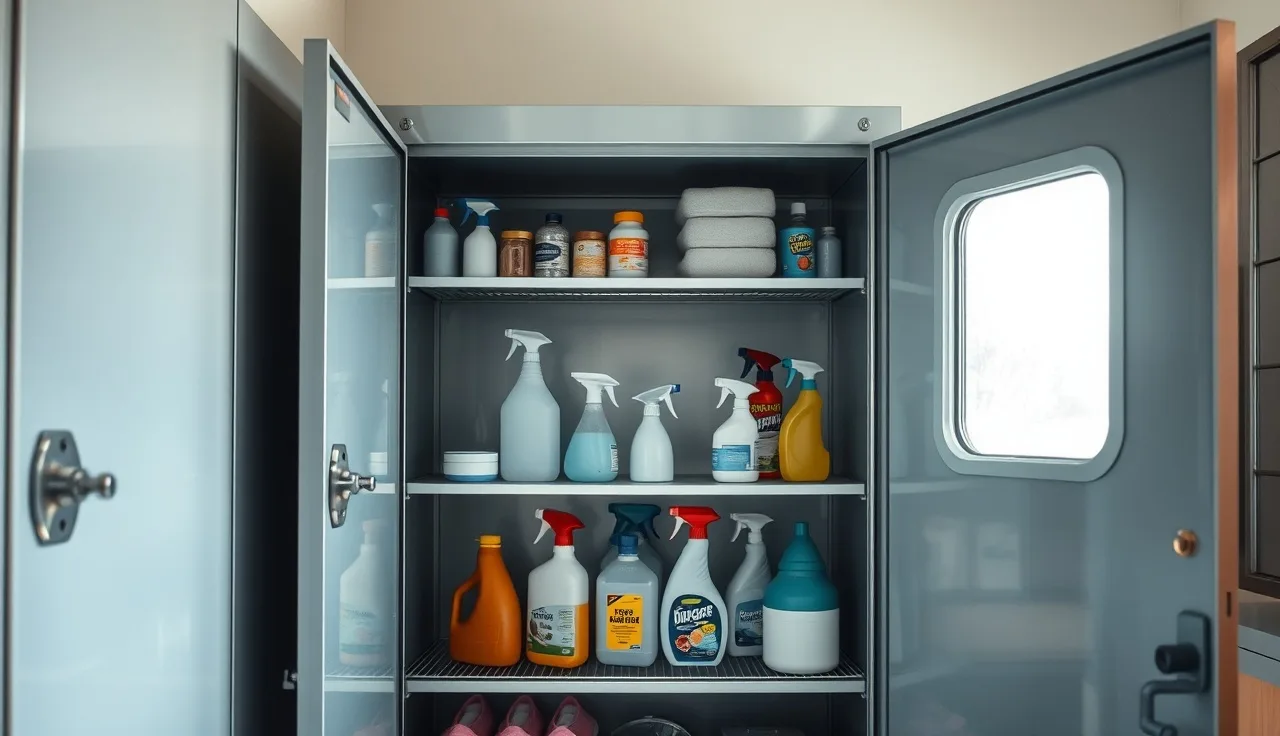
Licensed childcare facilities must store cleaning products, disinfectants, and sanitizers in a locked cabinet or closet children cannot access, with original labels intact. Federal Child Care and Development Fund rules and every state licensing code require this. Unlocked chemical storage is one of the most cited inspection deficiencies in the country. Here is what the rules actually say and how to pass.
What do federal rules say about storing cleaning products in childcare?
Federal law sets the floor: hazardous materials, including every cleaning and sanitizing product, must be stored safely away from children. The Child Care and Development Fund, the block grant that funds childcare subsidies, sets minimum health and safety requirements every state receiving CCDF dollars must meet or exceed. Under 45 CFR 98.41, states must ensure childcare settings that receive CCDF funds address "the safe storage of hazardous materials." [1]
That language is broad on purpose. Congress left the specifics to state licensing agencies, so the exact lock and cabinet rules live in state code.
The Office of Child Care spells out the baseline in its health and safety guidance: cleaning products, disinfectants, and other hazardous substances must be stored in a locked area inaccessible to children. [2] States can require more. None can require less.
In practice, "inaccessible to children" means a physical lock, more than a high shelf. Inspectors in most states will cite you for a high shelf without a lock even if no child has ever come close to it. The rule is structural, not situational.
What are the most common state licensing rules for chemical storage?
State rules use different words but land on the same five requirements: locked storage, separate from food, original labels, labeled secondary containers, and products returned to locked storage right after use. Those show up in nearly every licensing code in the country.
| Requirement | Typical state rule |
|---|---|
| Location | Locked cabinet or closet, separate from food storage |
| Height alone | Not sufficient without a lock |
| Original labels | Required on all containers |
| Secondary containers | Must be labeled with product name and hazard |
| Accessibility during use | Product must be returned to locked storage immediately after use |
| SDS/MSDS sheets | Many states require them on file at the facility |
California's Title 22 regulations require that toxic and flammable materials be kept in a locked storage area at all times when not in use, and never stored in the same area as food. [3] Texas Minimum Standards require hazardous materials to be stored out of reach of children in a locked cabinet or closet. [4] Minnesota Rule 9502 requires cleaning supplies be stored in a place inaccessible to children with a working lock. [5]
The pattern holds coast to coast. Where states differ is mostly in how strict they get about secondary containers (spray bottles you fill yourself) and whether they demand Safety Data Sheets on file. Read your own state's licensing manual, because states like New York and Illinois publish detailed checklists that go past the generic language.
Building out a new facility or remodeling? Install a dedicated locked utility closet rather than retrofitting a cabinet. It costs more upfront and kills a recurring inspection headache. For home-based providers, a keyed or combination lock on a cabinet inside a utility room is the most common compliant setup. Read more about keeping your whole facility inspection-ready in our guide to daycare cleaning.
Which cleaning products actually have to be locked up?
Short answer: anything that would harm a child if swallowed or touched. That covers more products than most operators expect.
Regulators define the category as any product carrying a hazard warning on the label. That includes disinfectants (bleach solutions, quaternary ammonium compounds), sanitizers (food-contact and diaper-table sanitizers), all-purpose cleaners, floor cleaners, bathroom cleaners, drain openers, oven cleaners, insecticides, pesticides, and any aerosol spray. Hand soap, even antibacterial hand soap, usually is not covered because its hazard profile is low, though your state manual is the final word.
The EPA registers disinfectants under FIFRA, and every product registered as a disinfectant carries explicit hazard warnings. [6] If the label says "Keep out of reach of children," that product goes in the locked cabinet. Full stop.
Some providers assume "green" or plant-based cleaners are exempt. They are not, automatically. If the product carries a hazard warning, the storage rule applies no matter what the ingredient list says. A few plant-based products genuinely rate low enough that they may not need a locked cabinet under your state's code, but verify that product by product. Do not assume it as a category.
Here is the trap operators miss. Product left in a mop bucket. A spray bottle sitting on a counter. A cloth soaked in sanitizer left on a table. Most state rules require products be returned to locked storage immediately after use. A labeled spray bottle sitting on a bathroom shelf while children are present is a violation in many states, even when the main supply is locked tight.
Does a high shelf count as proper storage, or does it have to be locked?
A high shelf alone does not meet requirements in any state I am aware of. It has to be locked. This is one of the most stubborn misunderstandings among home-based providers.
The standard is that children cannot access the storage area, and regulators read "cannot access" as a physical barrier with a lock, more than a height advantage. A determined three-year-old on a stepstool defeats the high-shelf strategy. So does a six-year-old who can climb. Licensing rules are written to survive both.
A few states allow a high-mounted hook-and-eye latch as an alternative for cabinet doors if every child in care is under a certain age, but that is rare and usually limited to family child care homes. Do not assume it applies to you without reading your state's specific rules.
Buy a keyed cabinet lock or a hasp-and-padlock for any cabinet holding cleaning products. They cost between $10 and $40 at any hardware store. That is the cheapest compliance fix in the licensing world.
What labeling rules apply to cleaning product containers in childcare?
Every container of cleaning product in a licensed facility must be in its original labeled container, or in a secondary container clearly labeled with the product name and any hazard warnings. [2] That rule has two practical edges.
First, you cannot pour a disinfectant into an unlabeled spray bottle and walk away. The spray bottle needs a label. Most programs use peel-and-stick labels or a label maker. State language usually requires the product name at minimum; some states also want the dilution ratio when you mix a concentrate with water.
Second, original containers with damaged or missing labels are a citation waiting to happen. If the label peels off a bleach jug, replace the label or replace the jug. An inspector will flag an unlabeled container of white liquid even when you know exactly what it is.
OSHA's Hazard Communication Standard (29 CFR 1910.1200) requires employers to maintain Safety Data Sheets for hazardous chemicals used in the workplace. [7] If you have employees, even one part-time aide, you are an employer under OSHA and must keep SDS files. Many state childcare licensing agencies have adopted the same requirement in their own regulations. Keep a binder with the SDS for every product you use, and make sure staff know where it lives.
For centers running more than a handful of products, a simple inventory log listing each chemical, its storage location, and where its SDS is filed makes inspections faster and shows you run an organized operation.
How does poisoning risk data back up these storage rules?
The rules exist because the risk is real and counted. Children under six account for roughly half of all calls to poison control centers each year, and household cleaning products sit consistently among the top ten substance categories for that age group, per the American Association of Poison Control Centers annual report. [8]
Most pediatric poisoning deaths involve medications, not cleaners. But cleaning products drive a large share of non-fatal poisonings that land kids in the ER. A 2019 study in Pediatrics found that from 2000 to 2015, roughly 267,269 children under six were treated in emergency departments for cleaning product exposures, about 17,000 a year. [9] The products most often involved were bleach, laundry detergent packets (especially single-use pods), and all-purpose spray cleaners.
A childcare facility should be safer than the average home because it is regulated. The storage rules are the mechanism. Store products correctly and the chance of ingestion drops close to zero. Let storage slip and the outcome can be severe, because a facility concentrates both products and children in one space.
Cleaning product poisoning is almost entirely preventable with correct storage. That is why inspectors treat an unlocked cabinet as a high-priority deficiency, not a paperwork technicality.
What happens during an inspection if cleaning products are stored incorrectly?
Improper chemical storage is one of the most frequently cited deficiencies in childcare licensing inspections. Child Care Aware of America's licensing reporting notes that health and safety violations, chemical storage among them, are among the top categories generating corrective action plans and fines across states. [10]
In most states, an unlocked cleaning cabinet is a non-compliance finding that triggers a written corrective action plan with a short cure deadline, often 24 to 72 hours. Repeat violations escalate fast. A second citation for the same problem can bring a monetary fine, a provisional license, or in some states a suspension of enrollment until you fix it.
A few states classify improper hazardous material storage as an immediate health and safety threat. That can force an on-the-spot correction before the inspector leaves. Lock the cabinet before they walk out the door, or pull the products from the facility temporarily.
The consequences reach past licensing. If a child is hurt because of bad storage, your liability exposure dwarfs any licensing fine. Your daycare liability insurance matters here, and most insurers ask whether the facility meets all licensing requirements as a condition of coverage. An unlocked cabinet documented in an inspection report is written evidence of non-compliance that could complicate a claim.
The ChildCareComp compliance toolkit has a chemical storage checklist you can print and post near your supply area, so staff can run a quick check before children arrive each morning.
Are there different rules for home daycare versus a childcare center?
Yes, though the core requirement (locked, inaccessible storage) applies in both. The differences show up in physical requirements and level of detail.
Licensed family child care homes (what most people call home daycare) often get a little more flexibility in how they hit compliance. A locked utility room, a keyed cabinet under the sink, or a locked closet all typically satisfy the rule. Some states let family child care homes use a key-operated lock on an entire room instead of a separate cabinet, which is easier to pull off in a house.
Centers usually face more prescriptive rules: dedicated storage rooms, ventilation for flammable or volatile products, fire code compliance for larger quantities, and more detailed SDS documentation. Centers with more employees also face full OSHA Hazard Communication compliance, including written programs and staff training.
Home-based providers should also know their homeowner's or renter's policy usually does not cover a licensed childcare operation. A separate home daycare insurance policy typically covers liability and property tied to the childcare business. Some insurers ask specifically about chemical storage compliance during underwriting.
Just getting started as a home provider? Read your state's family child care licensing manual cover to cover before your first inspection. The storage rules usually sit in a section called "Health and Safety" or "Environment," and they are written plainly enough that you do not need a lawyer to read them.
What should a compliant cleaning product storage setup actually look like?
Here is what I would set up if I were opening a facility today.
For a center, I would designate a utility closet with a key lock on the door. It stays locked any time children are present. Inside: shelving organized by product type, all original containers with intact labels, an SDS binder mounted on the wall inside the door, and a printed inventory list. Three copies of the key. One in the director's office, one in a lockbox with the spares, one carried by the staff member responsible for cleaning. Nobody else gets a key.
For a home-based provider, a locking metal cabinet (the kind sold for tool or first aid storage) mounted to the wall inside a utility room or laundry area works well. Figure $50 to $150. [4] Put a combination padlock on it if you would rather not track keys. Post a laminated checklist on the outside listing every product that should be inside.
In both settings, one protocol matters most: the product goes back into locked storage immediately after each use. Not at the end of the cleaning task. Not after the last child leaves. Immediately after each use. That is the step most facilities skip and most inspectors catch.
Every staff member who handles cleaning products should read the SDS for each one. This does not have to be formal training every time, but make it part of onboarding and document it. A sign-off sheet in the SDS binder does the job.
Do cleaning product storage rules apply to sanitizers used for diapering and food surfaces?
Yes. This catches some providers off guard, because sanitizers are in use all day. The rule still applies the moment a product is not actively being used.
The EPA categorizes sanitizers as pesticides under FIFRA when they carry public health claims. [6] Quaternary ammonium sanitizers on diaper tables, bleach solutions on food-contact surfaces, and spray sanitizers on toys all carry hazard warnings and all belong in locked, inaccessible storage between uses.
The workflow most compliant facilities run: mix the sanitizer solution at the start of the day, set the labeled spray bottle in a designated spot out of children's reach and in adult line of sight (a high counter, for example), use it through the day, and return it to the locked cabinet when the active program period ends. If the program runs nonstop, the bottle never sits within a child's reach at any point.
Bleach solutions carry an extra wrinkle: they degrade fast. The CDC recommends preparing fresh bleach solution daily for surface sanitation. [11] You are mixing a fresh batch every morning anyway, which means the large bleach container stays in locked storage and only a day's worth of solution comes out, in a labeled secondary container.
Check your state's childcare health consultant resources for locally adapted sanitizer guidance. Most state health departments publish a version of this workflow.
How do you train staff to follow cleaning product storage rules correctly?
Rules without training are words on paper. Most storage violations happen not because a director ignored the requirement, but because a staff member set a spray bottle on the counter without thinking.
OSHA requires that employees who work with hazardous chemicals get trained on the Hazard Communication Standard, including how to read an SDS and what the hazard labels mean. [7] That training has to be documented. For a center, that means every employee who ever touches a cleaning product, including part-time aides and substitutes, needs at least basic chemical safety training.
Home-based providers with no employees do not carry formal OSHA obligations, but documenting your own familiarity with the SDS for each product is still smart, and inspectors may ask about it.
A training approach that works: put a 15-minute chemical storage walkthrough in every new employee orientation. Show the locked cabinet, show where the keys are, show the SDS binder, and have the employee sign a statement that they were trained. Run a quick refresher annually, or any time you add a new product. It takes almost no time and it protects you.
One small thing that actually works: a sticky note or laminated sign on the inside of the cabinet door that reads "Return immediately after use." Physical cues cut down the "I just set it down for a second" slip that generates inspection violations.
What records do you need to keep related to cleaning product storage?
The paperwork is light, but it is real. At minimum, most state licensing regulations require current Safety Data Sheets for every hazardous chemical used at the facility. [7] Keep them in a physical binder (inspectors want to flip pages, not log into a portal), organized alphabetically or by category, updated whenever you switch products.
Many states also require a written policy on chemical storage, handling, and disposal as part of your health and safety policies. Usually one page: where products are stored, who has access, how staff are trained, and what happens after an exposure. If your state requires it, it belongs in your policy manual, signed by your director.
A product inventory list (product name, manufacturer, SDS location, storage spot) is not always required by regulation, but it makes inspections faster and cuts the odds of an inspector flagging a product you forgot to pull an SDS for. I would keep one and update it quarterly.
If a chemical exposure happens, document it right away: what product, what child or staff member, what happened, what steps you took, and whether you called poison control or emergency services. Most states require incident reporting for any accidental exposure. Keep the report in the child's file and in the facility's incident log.
For providers who want this organized, the ChildCareComp compliance toolkit includes a chemical storage policy template and an SDS binder checklist built around the most common state requirements.
Frequently asked questions
Can I store cleaning products in a cabinet that uses a childproof latch instead of a key lock?
Most states do not accept childproof latches as a substitute for a keyed or combination lock in licensed childcare settings. Childproof latches are designed for homes with a single child, not rooms full of children where staff need consistent access. Check your state's exact language. If it says "locked cabinet," assume a keyed or combination lock is required.
Do hand sanitizers and soap have to be locked up in daycare?
Standard hand soap generally does not require locked storage because its hazard profile is low and it carries no hazard warning. Hand sanitizer is different. It contains 60-70% ethyl alcohol, carries a flammability and ingestion warning, and must be locked up in most states between uses. It also cannot sit in a dispenser within reach of children under a certain age, typically under five. Confirm with your state's rules.
What concentration of bleach solution is allowed for sanitizing in daycare?
The CDC recommends roughly 1 tablespoon of unscented liquid chlorine bleach per gallon of water (about 50-200 ppm available chlorine) for sanitizing food-contact and diapering surfaces. Many state health departments name the same range. Mix fresh daily, because bleach solutions degrade quickly. Use unscented household-strength bleach, never concentrated industrial bleach.
Is there a federal standard that specifies exactly how cleaning products must be locked up in childcare?
Federal law (45 CFR 98.41) requires states to ensure safe storage of hazardous materials in CCDF-funded settings, but it does not specify the type of lock or cabinet. Each state's licensing regulations set the specifics. Office of Child Care guidance clarifies that storage must be in a locked area inaccessible to children, which every state has folded into its licensing rules in some form.
Can cleaning products be stored in the same closet as food or medication?
No. Nearly every state licensing code explicitly bars storing cleaning products or other hazardous materials in the same area as food, formula, or medication. Cross-contamination risk and the chance of a staff member grabbing the wrong container make co-storage a real hazard. Cleaning products need their own dedicated locked storage, separate from anything that goes into or near a child's body.
What should I do if a child gets into a cleaning product at my daycare?
Call Poison Control immediately at 1-800-222-1222 and follow their instructions. If the child has difficulty breathing, burns to the mouth or skin, or loss of consciousness, call 911 first. Notify the child's parent as soon as it is safe to do so. Document everything: what product, how much, what time, what symptoms, what actions. File an incident report as required by your state agency, which typically must happen within 24 hours.
Do I need to provide Safety Data Sheets for cleaning products in a home daycare?
OSHA's Hazard Communication Standard applies to employers, so with no employees you are technically not required to keep SDS files under federal OSHA. But many state childcare licensing agencies independently require SDS sheets for all hazardous chemicals at licensed home daycares, regardless of employment status. Check your state's family child care licensing manual. Even where it is not required, a simple SDS binder is good practice.
How often do inspectors actually check cleaning product storage?
In most states, chemical storage sits on the standard inspection checklist and gets checked at every routine licensing visit. It is easy to observe and clearly pass-or-fail, so it rarely gets skipped. Child Care Aware of America reporting shows health and safety categories including chemical storage are among the most consistently checked items nationally. Surprise visits, where states run them, also check storage because it reflects daily practice, more than inspection-day prep.
Are disinfectant wipes like Clorox or Lysol wipes subject to storage rules?
Yes. Pre-moistened disinfectant wipes are EPA-registered disinfectants and carry hazard warnings including "keep out of reach of children." They belong in locked, inaccessible storage when not in active use. This surprises many providers because wipes feel less dangerous than liquid bleach, but the regulations put them in the same category. A container of wipes left on a changing table while children are present is a violation in most states.
Can a teacher keep a spray bottle of sanitizer in the classroom during the day?
It depends on your state's rules and how "in use" is defined. Some states allow a labeled sanitizer spray bottle to stay in a classroom during operating hours if it sits on a high surface out of children's reach. Others require it back in locked storage any time it is not literally being applied to a surface. Read your state's exact language. When in doubt, the locked storage rule is the safer read, and it is what most inspectors expect.
What is the fine for storing cleaning products incorrectly in a daycare?
Fines vary widely by state. A first offense is often a written notice requiring correction within 24 to 72 hours with no money attached. Repeat violations or failure to correct in time can bring fines from roughly $50 to $500 per violation in most states, with some states allowing higher penalties for repeat or egregious non-compliance. A pattern of health and safety violations can lead to license suspension or non-renewal, which costs far more than any fine.
Do I need special ventilation for storing cleaning products in daycare?
General ventilation requirements apply to any storage area holding volatile chemicals like bleach or ammonia-based cleaners. Most state licensing codes and fire codes require storage areas for hazardous materials to have enough air circulation to prevent vapor buildup. For a typical daycare with consumer-grade products in a utility closet, that usually just means the closet cannot be completely airtight. Store larger quantities or industrial-strength products and you should consult your state fire marshal for specific standards.
What cleaning products are actually approved for use in licensed childcare facilities?
State licensing agencies do not typically keep an approved product list, but they do require any sanitizer or disinfectant to be used according to label instructions and EPA registration. Products must fit the surface and purpose (food-contact vs. non-food-contact). Your state childcare licensing agency or health department may publish a recommended sanitizer and disinfectant list. The EPA's Safer Choice program lists products meeting safer ingredient standards, which many childcare health consultants recommend.
Sources
- U.S. Code of Federal Regulations, 45 CFR Part 98 (CCDF regulations): CCDF regulations at 45 CFR 98.41 require states to ensure childcare settings meet requirements for safe storage of hazardous materials
- Office of Child Care, HHS, Health and Safety Requirements in Child Care Settings: OCC guidance states that cleaning products, disinfectants, and other hazardous substances must be stored in a locked area inaccessible to children
- California Department of Social Services, Title 22 Child Care Center Regulations: California Title 22 requires toxic and flammable materials to be kept in a locked storage area at all times when not in use and not stored in the same area as food
- Texas Health and Human Services, Child Care Licensing Minimum Standards for Child Care Centers: Texas Minimum Standards require hazardous materials to be stored out of reach of children in a locked cabinet or closet
- Minnesota Department of Human Services, Family Child Care Licensing Rules (MN Rule 9502): Minnesota Rule 9502 requires cleaning supplies to be stored in a place inaccessible to children with a working lock
- U.S. Environmental Protection Agency, Pesticide Registration under FIFRA: The EPA registers disinfectants and sanitizers as pesticides under FIFRA; products registered as disinfectants carry explicit hazard warnings including keep out of reach of children
- OSHA, Hazard Communication Standard, 29 CFR 1910.1200: OSHA's Hazard Communication Standard requires employers to maintain Safety Data Sheets for hazardous chemicals and provide employee training on chemical hazards
- American Association of Poison Control Centers, Annual Report: Children under six account for roughly half of all calls to poison control centers each year, with household cleaning products consistently among the top ten substance categories
- Pediatrics, 2019, Emergency Department Visits for Pediatric Cleaning Product Exposures: From 2000 to 2015, approximately 267,269 children under six were seen in emergency departments for cleaning product exposures, about 17,000 per year on average
- Child Care Aware of America, Child Care in America State Fact Sheets: Health and safety violations including chemical storage are among the top categories generating corrective action plans and fines in childcare licensing inspections across states
- CDC, Cleaning and Disinfection for Community Facilities: The CDC recommends preparing fresh bleach solution daily for surface sanitation because bleach solutions degrade quickly