Last updated 2026-07-09
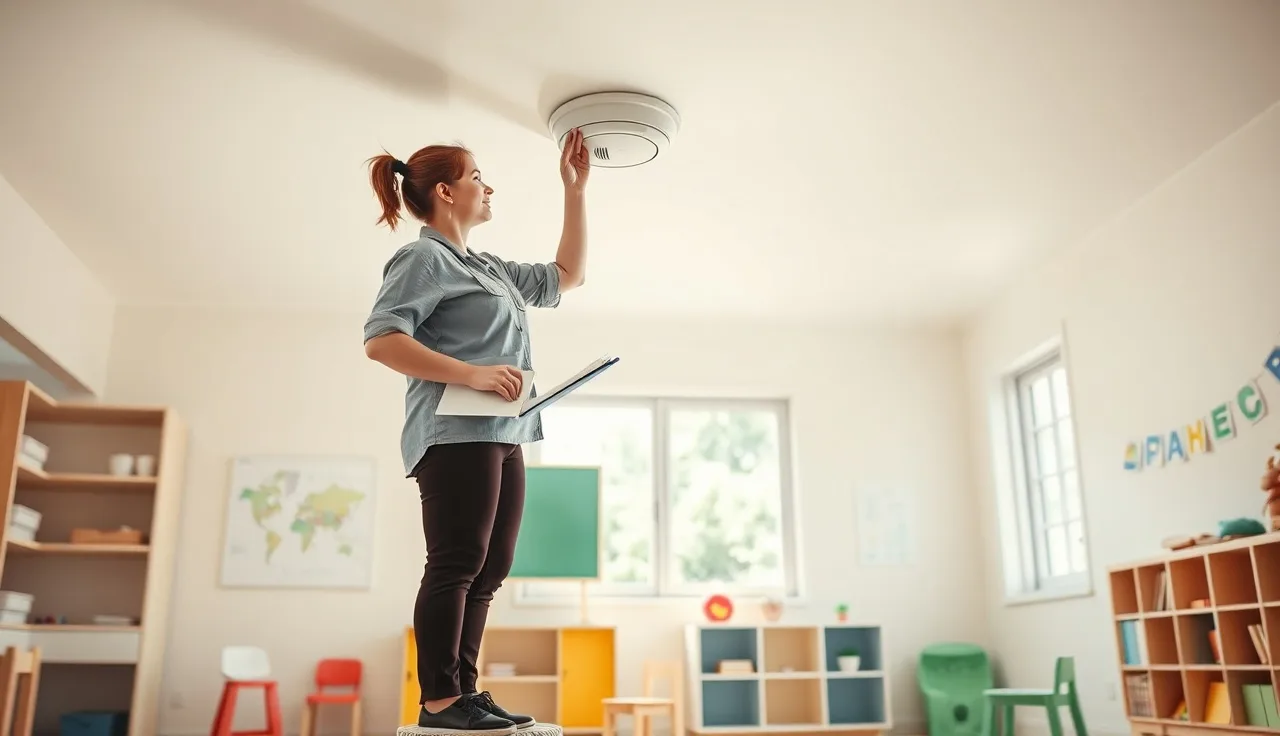
TL;DR
Every licensed childcare program in the U.S. must have working smoke detectors, though placement rules, alarm types, and testing frequency vary by state. Inspectors check your detectors and ask for a written testing log. Monthly testing with a dated, signed log is the baseline almost everywhere. Missing or untested detectors rank among the most cited licensing violations.
Why do smoke detectors matter so much to childcare licensing?
Fire is the scenario licensing agencies plan for hardest, and a working smoke detector is the thing that buys everyone time to get out. That escape window can be short. The U.S. Fire Administration warns that fire spreads fast in a furnished room, and modern furnishings burn faster than they did a generation ago, sometimes leaving occupants only a few minutes to escape [1].
Licensing agencies treat detectors as a threshold item. An inspector can write an immediate deficiency, put a program on provisional status, or shut it down on the spot if detectors are missing, dead, or disconnected. In practice, detectors are one of the first things checked on arrival. The inspector walks the space, presses every test button, and hunts for the testing log before they get anywhere near your staff-to-child ratios.
The federal Child Care and Development Fund (CCDF) rules require states to set and enforce health and safety standards that include fire safety as a condition of getting federal childcare subsidy dollars [2]. So even if a state's own licensing code went soft, the CCDF framework pushes it to keep real fire safety standards on the books. Every state takes CCDF money. Every state must inspect licensed programs for compliance.
What are the federal baseline rules for smoke detectors in childcare?
No single federal statute sets smoke detector specs for childcare facilities. The CCDF regulations at 45 CFR Part 98 require states to have health and safety standards covering fire safety, but the exact detector rules are left to state licensing agencies and local fire codes [2].
The National Fire Protection Association's NFPA 101, Life Safety Code, is the document most states point to when they write childcare fire rules [3]. NFPA 101 requires that smoke alarms in new construction comply with NFPA 72, the National Fire Alarm and Signaling Code, which sets standards for alarm sensitivity, interconnection, and battery backup [7]. Plenty of state childcare regulations just say smoke detectors must meet NFPA 72 and leave it at that.
The Consumer Product Safety Commission recommends smoke alarms on every level of a building, inside each sleeping area, and outside each sleeping area [4]. Those recommendations line up closely with what state licensing agencies require for childcare.
So the floor is federal: states must have fire safety standards. The detector specs themselves come from state licensing regulations and local fire codes, which nearly always point back to NFPA.
Where exactly do smoke detectors need to be installed in a childcare facility?
Placement is where providers fall short most often. Most state licensing rules require detectors in every room where children sleep or nap, in every hallway serving those sleeping areas, on every floor, and in any room where children are cared for [3].
Here's what that looks like on the ground:
- A home daycare with a nap room in the basement needs a detector in that room, in the hallway outside it, and on the main floor.
- A center with several classrooms needs one in each classroom plus more than one in the main hallway.
- Kitchens are the tricky spot. Rules often require a detector near but not directly over cooking appliances, to cut down on nuisance alarms. Check your state's minimum distance from a stove or oven.
- An attached garage almost always needs a detector, even if children never set foot in it, because garage fires reach occupied space fast.
Some states split hairs between single-station and interconnected alarms. Interconnected systems, where every alarm sounds the moment one triggers, are required by many state rules for facilities above a certain size or occupancy. If your state requires interconnection and you're running standalone battery units, that's a citation waiting to happen.
Spacing and square-footage thresholds differ too. California's Title 22 rules, for example, put detectors no more than 30 feet apart in corridors [5]. Texas childcare rules reference both the state fire marshal's rules and NFPA 101 [6]. Read your own state licensing handbook. A general home safety guide will not get you licensed.
What types of smoke detectors are acceptable for licensed childcare?
Two main sensing technologies exist: ionization and photoelectric. Ionization detectors respond faster to fast-flaming fires. Photoelectric detectors respond faster to slow, smoldering fires, which are actually more common in residential-style settings. The CPSC says having both types, or a combination unit, gives the best protection [4].
Some state rules name dual-sensor or combination alarms outright. Others just require "UL-listed" detectors, meaning they meet Underwriters Laboratories standards, and say nothing about the technology. If your rule says UL-listed and stops there, either type generally works.
For programs serving children who are deaf or hard of hearing, or programs that care for children overnight, many state rules require alarms with strobe lights or bed-shaking components. That usually falls under state disability accessibility rules on top of the licensing rules.
Carbon monoxide detectors are a separate animal. Many states now require CO detectors in facilities with gas appliances, attached garages, or fossil-fuel heating. Some states fold the CO requirement into the same rule as smoke detectors; others keep a separate regulation. A combination smoke/CO unit satisfies both in many places, but confirm with your licensing agency before you buy.
Battery backup is required by most state rules even for hardwired detectors. A hardwired unit that dies in a power outage is not acceptable. Inspectors look for the green power light and sometimes cut building power mid-inspection to test the backup battery. Sealed 10-year lithium battery detectors are accepted under NFPA 72 and allowed in most states [7]. They kill the old problem of staff yanking batteries during a cooking-smoke episode.
How often do you have to test smoke detectors in a licensed childcare program?
Monthly testing is the standard almost everywhere. Most state licensing rules require detectors to be tested at least once a month, with the test documented in a written log [5][6]. Some states require weekly testing in facilities that care for children overnight or serve infants.
Testing means pressing the test button until the alarm sounds. It is not glancing at a green light. The green light does not confirm the sensing chamber works. The test button confirms the electronics and the sounder, not the sensing chamber the way a calibrated aerosol test would, but monthly button tests plus annual professional inspections are what the rules actually ask for.
Battery schedules matter too. Most rules require batteries in non-sealed detectors to be replaced at least once a year, or the moment the low-battery chirp starts. Some states want the battery replacement date in the log.
Annual inspections by a qualified fire safety professional are required in some states, mostly for licensed centers. That inspector uses calibrated equipment to check that detector sensitivity is still in range. Home daycare providers are less often required to have a professional inspection, but confirm it with your licensing agency rather than assume.
What does a proper smoke detector testing log look like?
A smoke detector testing log is a written record, signed by whoever ran the test, showing the date, the location of each detector tested, the result (pass or fail), and any corrective action taken. That's the minimum most state licensing agencies expect [5][6].
Here's what a basic monthly log should capture:
| Column | What to Record |
|---|---|
| Date | Exact date of test |
| Detector location | Room name or unit number |
| Test result | Pass / Fail / Battery replaced |
| Tested by | Staff name (print and sign) |
| Corrective action | What was done if the detector failed |
| Next scheduled test | Optional but useful |
Some states hand out a template through their licensing website. If yours does, use theirs. It signals to the inspector that you know where the official resources live and that you're on the expected format.
Keep logs for at least the span between inspections, usually one to three years. Many seasoned providers hold them three years no matter what the state minimum says, because licensing disputes sometimes reach back into earlier inspection cycles.
Store the log where an inspector can grab it fast. They don't want to stand around while you dig. A binder labeled "Fire Safety" by the main entry is the simple, practical move. The ChildCareComp compliance toolkit includes a printable testing log template you can adapt to your state's fields.
One thing providers miss: when a detector fails a test, the corrective action column matters more than the failure. "Failed, replaced immediately, retested and passed" reassures an inspector. "Failed" with a blank corrective action column does the opposite.
What are the most common smoke detector violations found during childcare licensing inspections?
The most common citations, based on patterns state licensing agencies and fire marshals report, fall into five buckets.
Missing detectors. Providers forget to add one when they open a new care space, like a finished basement or an added classroom. Any room where children are present usually needs one.
Dead or disconnected detectors. Staff pull a detector to stop nuisance alarms during cooking and forget to reconnect it. That's a serious violation. If cooking smoke keeps setting things off, the fix is moving the detector farther from the stove or switching to a photoelectric unit, which shrugs off cooking smoke better. The fix is never removing the alarm.
Missing or incomplete testing logs. The log is often the first document an inspector asks for. Working detectors with no log still draws a documentation citation.
Expired detectors. Smoke detectors carry a manufacturer replacement age, typically 10 years from the manufacture date (not the purchase date). That date is printed on the back of the unit. Many inspectors check it now, and some state rules require detectors to be within their service life.
Wrong type or placement. A detector too close to a cooking area, too far from a sleeping room, or one that misses interconnection requirements where interconnection applies. These show up most at initial licensing inspections when a provider is setting up a new space.
For home daycare providers, a smart companion step is reviewing your home daycare insurance policy. Many policies require working smoke detectors as a condition of coverage, and a documentation gap could complicate a claim.
Do smoke detector rules differ for home daycares versus licensed childcare centers?
Yes, often by a lot. Home daycare programs, sometimes called family childcare homes, are usually regulated by the same state agency as centers but under a separate rulebook. The home rules tend to be lighter on interconnection and professional inspection frequency, but the basic placement and monthly testing requirements typically apply to both [5].
Providers who run a daycare out of their own residence sometimes get tangled up over which rules apply, the childcare licensing rules or general residential building codes. The answer is both. You must meet the childcare licensing requirements for the spaces used for care, and those are usually tougher than standard residential codes.
Here's a concrete example. A standard residential code might require detectors only in sleeping rooms and hallways. A childcare licensing rule for the same home might require detectors in every room where children receive care, which could pull in the living room, the kitchen area, and the playroom.
Large licensed centers sometimes get annual state fire marshal inspections on top of licensing visits. Home daycares rarely face fire marshal inspections on their own, but licensing inspectors are trained to check the same items.
State rules vary enough that generalizations only carry you so far. California Title 22 [5], the Texas HHSC minimum standards [6], and New York's Office of Children and Family Services rules each read differently. Reading your own state's regulations is not optional.
What happens if a smoke detector is not working during a licensing inspection?
It depends on the severity and the inspector's read of the situation. A single detector with a dead battery that you swap right there while the inspector watches usually gets logged as a deficiency but marked corrected on-site, which is the best outcome you can get. An inspector who finds several missing detectors, or detectors deliberately disabled, is likely to write a serious deficiency that triggers a corrective action plan.
Serious deficiencies come with a plan of correction and a short deadline, often 30 days or less. Repeated or uncorrected fire safety violations can lead to provisional licensure, suspension, or revocation. Those outcomes are rare, but they're real, and they almost always trace back to a provider who skipped monthly testing and never caught the problem early.
Your testing log is your insurance policy. A provider with monthly tests and dated logs showing every test passed has documented evidence of good-faith compliance. A provider with no log has no defense when an inspector finds a dead detector.
If you get a deficiency for a smoke detector issue, respond in writing, attach any receipts for replacement detectors, and restart your testing log from the correction date. Inspectors want a pattern of compliance, not a flawless single moment.
How do smoke detector requirements connect to other fire safety requirements for childcare?
Detectors don't stand alone. Licensing agencies look at your fire safety program as a whole, and detectors are one piece alongside fire extinguishers, emergency exit plans, evacuation drills, and exit signage [3].
Most state rules require fire drills at least once a month for licensed centers and at least twice a year for home daycares, though frequencies vary. Some states want drills run at different times of day and in different weather so children and staff are ready no matter the conditions. Drill dates and results go in a separate fire drill log, not the smoke detector log.
Fire extinguishers typically need annual professional inspection, a tag showing the inspection date, and placement that keeps them accessible and matched to the fire risk (ABC-rated for general use). The extinguisher tag is a routine inspector check.
Emergency evacuation plans must be posted near exits in most states. The plan shows the layout, the primary and secondary exit routes, and the outside meeting point.
For home daycare providers newer to fire safety compliance, reviewing your daycare liability insurance alongside your fire safety checklist is worth the time. Both touch the same risk areas.
A clean fire safety record, meaning passed inspections and complete logs, also ties into daycare cleaning and general facility upkeep, because the same inspectors who press your test buttons also look at whether the space is kept in a way that doesn't create fire hazards.
How do you build a smoke detector maintenance schedule that actually holds up to inspection?
Providers who never get cited for detector issues do two things without fail: they put testing on a fixed calendar date each month, and they never let the log leave the building.
Pick the first Monday of every month, or the first business day, and drop it into the staff schedule as a standing task. Assign it to a named person, not "whoever's around." If that person is out, the backup completes and signs the log. Fuzzy responsibility is exactly how logs don't get done.
After testing, spend two minutes confirming each detector's manufacture date is in your records. Anything older than 10 years gets replaced before an inspector raises it.
Keep the right replacement batteries on-site at all times. Running to the hardware store when a battery dies mid-test is how gaps open in the log.
For centers with many rooms and many detectors, a simple numbering system helps. Label each detector with a small number (1, 2, 3...) and list them by number on the log form. Anyone running the test can then confirm every detector got checked, and an inspector can match the log to the physical units by number.
The ChildCareComp compliance toolkit has a fire safety calendar template that folds detector testing, drill scheduling, and extinguisher inspection tracking into one document. Whatever system you run, consistency across years is what protects the license.
Frequently asked questions
How often do smoke detectors need to be tested in a licensed daycare?
Monthly testing is the standard across nearly all state licensing rules. Some states require weekly testing in facilities that care for infants or provide overnight care. The test must be documented in a written log with the date, detector location, result, and name of the staff member who ran it. Doing the test without writing it down does not satisfy the documentation requirement inspectors look for.
What should a daycare smoke detector testing log include?
At minimum: the date of the test, the specific location of each detector tested, the result (pass or fail), the name and signature of the staff member who ran it, and any corrective action taken if a detector failed. Some states also require the battery replacement date. Keep logs for at least the span between licensing inspections, and store them somewhere an inspector can reach immediately.
Do home daycares need the same smoke detector requirements as licensed centers?
Generally the same monthly testing and documentation requirements apply, but home daycare placement rules are sometimes lighter than center rules. Home daycares are typically required to have detectors in every room where children receive care, which is usually tougher than standard residential building codes. Check your state's family childcare home regulations specifically, not the center licensing rules, because they are often separate documents.
Can I use battery-only smoke detectors in a licensed childcare facility?
In many states, yes, but sealed 10-year lithium battery detectors are increasingly preferred because they remove the risk of staff pulling batteries. Some states and local fire codes require hardwired detectors with battery backup in newly constructed or renovated facilities. Check both your state licensing rule and your local fire code. If both allow battery-only, a sealed 10-year unit is your best practical choice.
How old can smoke detectors be in a licensed daycare before they need to be replaced?
Most manufacturers recommend replacing detectors 10 years from the manufacture date printed on the back of the unit. Some state licensing rules and NFPA 72 reference this 10-year service life. Inspectors are checking manufacture dates more often now. Replace any detector 10 years old or older regardless of whether it passes a button test, because the sensing chamber degrades over time even when the electronics still work.
What types of smoke detectors are required for childcare facilities?
Most state rules require UL-listed detectors without naming ionization versus photoelectric technology. Dual-sensor or combination detectors are recommended by the CPSC because they respond to both fast-flaming and slow-smoldering fires. Combination smoke and carbon monoxide detectors are accepted in most jurisdictions and satisfy both requirements at once. If you care for children who are deaf or hard of hearing, check whether your state requires strobe or vibrating alarm components.
Do licensed daycares need carbon monoxide detectors as well as smoke detectors?
Many states now require CO detectors in facilities with gas appliances, attached garages, or fossil-fuel heating. Requirements vary: some states fold CO into the smoke detector rule; others keep a separate regulation. A combination smoke/CO detector is accepted by most state agencies. Check your specific state rule. CO requirements have expanded a lot since 2010, so even if your facility passed three years ago, the rule may have changed.
What happens during a licensing inspection if a smoke detector fails or is missing?
A single failed detector corrected on-site while the inspector watches is usually cited as a deficiency but marked corrected. Multiple missing or disabled detectors, or no testing log, typically bring a written deficiency requiring a corrective action plan within a short deadline, often 30 days or less. Repeat violations can lead to provisional licensure or suspension. Your testing log is your primary documentation of good-faith compliance.
Are interconnected smoke alarms required in childcare centers?
Many states require interconnected alarms in licensed centers above a certain size or occupancy, meaning when one detector sounds, all of them sound at once. NFPA 72 and NFPA 101 require interconnection in new construction above certain thresholds. Home daycares are less often required to have interconnected systems, but some states require them in all licensed childcare spaces regardless of size. Check your state licensing regulations and local fire code.
Does CCDF funding require specific smoke detector standards?
The federal CCDF regulations at 45 CFR Part 98 require states to establish and enforce health and safety standards that include fire safety as a condition of receiving federal childcare funds. The specific detector placement and testing standards are set by each state's licensing agency, not the federal rule directly. Because all states take CCDF funding, all states must maintain and enforce fire safety standards through their licensing programs.
How far apart do smoke detectors need to be placed in a childcare facility?
Spacing requirements come from NFPA 72 and get adopted by state licensing rules with some variation. California Title 22 puts detectors no more than 30 feet apart in corridors. NFPA 72 generally calls for detectors no more than 30 feet from any point in a room under standard ceiling conditions. Your state's childcare rule may state a specific maximum or simply reference NFPA 72. Check your state's rule for the binding number.
Can a daycare be shut down for smoke detector violations?
Yes, though immediate closure is reserved for the worst cases, typically multiple missing or disabled detectors in a facility with children present. More often, violations bring a deficiency notice and a correction deadline. Facilities that repeatedly fail fire safety inspections or miss correction deadlines face license suspension or revocation. The risk is real enough that monthly testing and complete logs are worth the fifteen minutes they take.
Do smoke detector logs need to be kept for a specific number of years?
State requirements vary. Many licensing agencies require records kept for at least one to three years. Keeping logs for three years is a reasonable practice regardless of state minimums, because licensing disputes or incident investigations sometimes reach back into earlier inspection cycles. Store logs on-site in an accessible spot; inspectors typically want to review them without waiting.
Sources
- U.S. Fire Administration, FEMA, Home Fire Safety: A working smoke detector gives occupants enough time to evacuate before smoke becomes incapacitating, with escape windows measured in minutes in furnished room fires.
- U.S. Department of Health and Human Services, Administration for Children and Families, Child Care and Development Fund (45 CFR Part 98): CCDF regulations require states to establish and enforce health and safety standards including fire safety as a condition of receiving federal childcare funds.
- National Fire Protection Association, NFPA 101 Life Safety Code: NFPA 101 sets requirements for smoke alarm placement, interconnection, and evacuation in occupancies including childcare facilities; most state licensing rules reference this code.
- U.S. Consumer Product Safety Commission, Smoke Alarms: CPSC recommends smoke alarms on every level of a building, inside each sleeping area, and outside each sleeping area; combination ionization/photoelectric detectors provide the best protection.
- California Department of Social Services, Community Care Licensing (Title 22 Regulations): California Title 22 specifies smoke detector placement in childcare facilities at distances no greater than 30 feet apart in corridors and requires monthly testing with documentation.
- Texas Health and Human Services Commission, Child Care Licensing Minimum Standards: Texas childcare minimum standards require smoke detectors meeting NFPA 101 in all rooms used for childcare, with monthly testing and written records.
- National Fire Protection Association, NFPA 72 National Fire Alarm and Signaling Code: NFPA 72 sets standards for smoke alarm sensitivity, interconnection, and battery backup; smoke detectors must be replaced 10 years from the manufacture date.
- Child Care Aware of America: Child Care Aware of America tracks state licensing standards including fire safety requirements as part of childcare quality and compliance reporting.
- U.S. Fire Administration, FEMA, Fire Safety in Child Care Facilities: The U.S. Fire Administration identifies missing or disabled smoke detectors as a leading fire safety deficiency in childcare facility inspections.