Last updated 2026-07-09
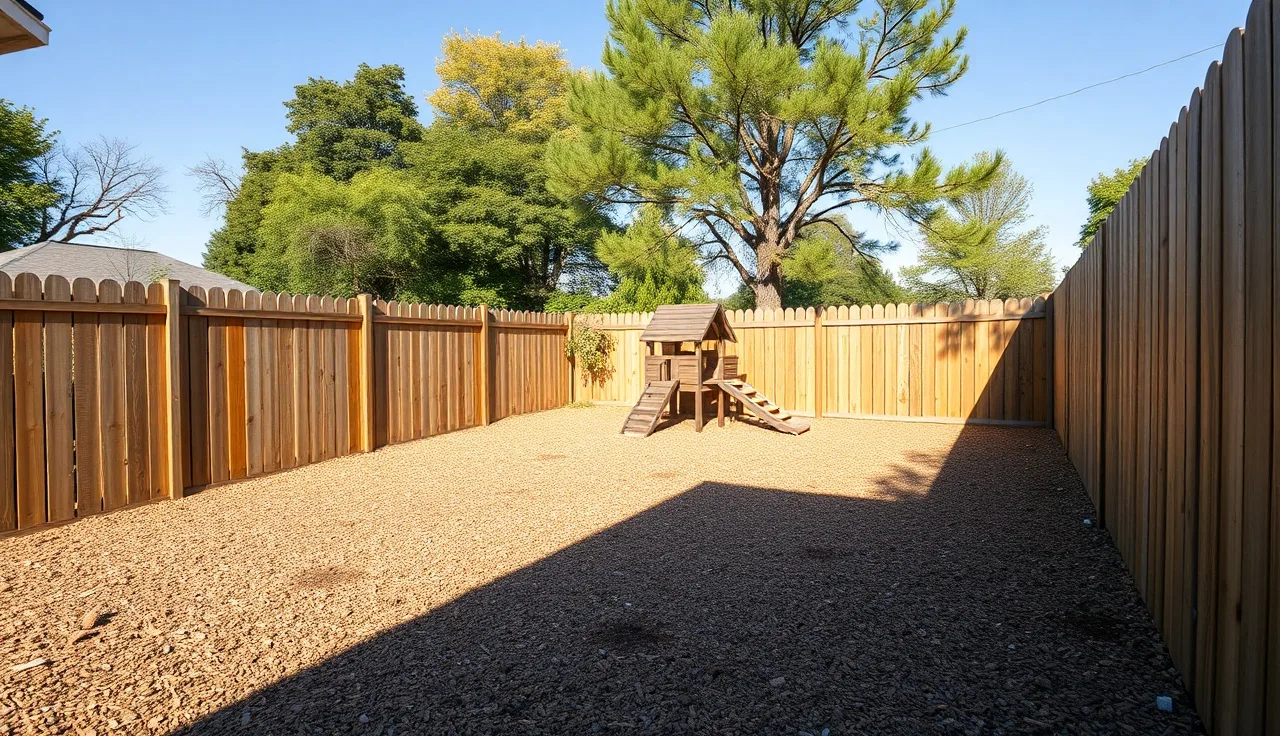
TL;DR
Most states require a minimum 4-foot fence (many require 6 feet) around all licensed daycare outdoor play areas, with no gaps wider than 3.5 inches and self-latching gates. Surfacing under climbing equipment must meet CPSC fall-height standards, typically 6 to 12 inches of loose-fill or engineered wood fiber. Exact rules vary by state, but federal CCDF quality standards and CPSC guidelines set the practical floor.
What federal rules apply to daycare outdoor play space fencing?
No single federal law dictates exactly what your fence looks like. Two federal frameworks set expectations that flow down to every state licensing agency, and inspectors lean on both.
The Child Care and Development Fund (CCDF) requires that states receiving federal subsidy dollars maintain health and safety standards covering outdoor play environments. The Administration for Children and Families final rule published in 2016 requires that licensed providers keep outdoor play spaces safe, which licensing agencies then interpret through their own fence-height and enclosure rules. [1]
The Consumer Product Safety Commission (CPSC) Handbook for Public Playground Safety is the other document inspectors actually reference. It isn't a regulation, but most state licensing rules are written to match or exceed its recommendations. The handbook says fencing and barriers should keep children away from hazards, and it treats any opening larger than 3.5 inches as a possible entrapment risk for a child's head or neck. [2]
So the federal baseline says you need an enclosed, safe outdoor space. Your state fills in the specifics. If your state rule is silent on a detail, expect a licensing inspector to cite the CPSC handbook as the de facto standard.
What fence height do most states require for licensed daycare?
Four feet minimum is the most common state requirement. A meaningful number of states, including California, Texas, and New York, require 6 feet under at least some conditions, especially when the play area borders a street, parking lot, or body of water. [3]
The table below shows fence height requirements across a representative sample of states:
| State | Minimum fence height | Notes |
|---|---|---|
| California | 4 ft (center), 6 ft near traffic | Title 22, Div. 12 |
| Texas | 4 ft minimum | DFPS Child Care Licensing |
| New York | 4 ft general, 6 ft near street | OCFS Part 418 |
| Florida | 4 ft | Fl. Admin. Code 65C-22 |
| Illinois | 4 ft | DCFS Rule 406 |
| Pennsylvania | 4 ft | DHS Chapter 3270 |
| Colorado | 4 ft | CDHS Rule 7.702 |
| Georgia | 4 ft, self-latching gate required | DECAL Rule 591-1-1 |
| Minnesota | 4 ft | DHS Rule 9503 |
| Ohio | 4 ft | OAC 5101:2-12-16 |
These figures come from publicly posted state licensing regulations. Always check your state agency's current rule, because amendments happen. [3][4]
Home daycares sometimes get a break. Maryland allows 3.5 feet for family providers, and some states accept an existing residential fence if it meets the opening and latch standards. Others apply the same commercial standard no matter the setting. Check both your state's family childcare rules and any county zoning ordinance, because those two sets of requirements don't always agree.
What counts as an approved fence material and design?
Chain-link, wood privacy board, vinyl panel, and welded wire are all commonly accepted. What regulators disallow is anything with footholds a child can climb (open chain-link is technically allowed, but horizontal rails that work like a ladder are not), gaps over 3.5 inches in any dimension, and any protrusion that could snag clothing or catch a child's head. [2]
The CPSC handbook flags "head entrapment zones," which are openings with a diameter between 3.5 and 9 inches. Your fence openings should be either smaller than 3.5 inches or larger than 9 inches. The 3.5-inch threshold comes from ASTM F1951 and related playground equipment standards, and most state rules cite that number directly.
Gate requirements are where providers most often fail inspections. Inspectors look for:
- Self-closing hinges (the gate swings shut without help)
- Self-latching hardware a preschool-age child can't operate (typically the latch must sit at 54 inches or higher from the ground)
- No gap at the bottom greater than 3.5 inches
- Swing direction away from the play area, so children aren't struck when an adult enters
A padlock is not a substitute for a self-latching gate unless your license specifically allows it. A hook-and-eye latch a child can reach is a common citation. Fix that before your inspector arrives.
What surfacing is required under playground equipment at a licensed daycare?
Surfacing requirements tie directly to fall height, which is the height of the highest accessible part of a piece of equipment. The CPSC handbook provides the depth chart that state licensing rules mirror. [2]
For loose-fill materials like engineered wood fiber (EWF), wood mulch, or pea gravel, the minimum uncompressed depth is 9 inches for fall heights up to 7 feet, and 12 inches for fall heights up to 10 feet. Pea gravel and sand are acceptable in many states but need deeper fill than EWF to hit the same impact protection.
The CPSC handbook states: "Loose-fill materials should be installed to a minimum depth of 9 inches for equipment with a fall height up to 7 feet." [2] That sentence gets quoted verbatim in licensing inspections.
Unitary surfacing, meaning rubber tiles or poured-in-place rubber, is acceptable and often preferred in center settings because depth maintenance is minimal. It's expensive, typically $10 to $20 per square foot installed, and the tiles must carry an HIC (Head Injury Criterion) rating for the specific fall height of your equipment. An HIC-compliant tile rated for a 6-foot fall is a different product than one rated for a 4-foot fall. Don't buy leftover tiles from a demolition project unless you have the manufacturer's HIC documentation.
ASTM F1292 is the standard method for measuring impact attenuation of surfacing. When a state inspector or licensing consultant asks whether your surfacing is "ASTM F1292 compliant," they're asking whether it can absorb a fall from the relevant height without exceeding 1,000 HIC. [5]
Wood decking, asphalt, concrete, and packed dirt fail under equipment in every jurisdiction. They're fine for pathways and transition zones. They cannot be the surface directly beneath any climbing structure, slide exit, or swing set.
What surfacing depth do you actually need to maintain over time?
This is the part providers underestimate most. Loose-fill compacts. It migrates. Children kick it out. An area that had 9 inches of EWF in September may have 4 inches under the swing by March, and that 4-inch depth is both a licensing violation and a real injury risk.
The CPSC handbook recommends checking surfacing depth at least monthly and after heavy rain or heavy use. Some licensing rules turn that into an inspection log requirement. California's Title 22 regulations require childcare centers to keep a documented playground inspection schedule. [4]
Buy more material than the initial install calls for. Keep a bag of EWF or mulch on hand. Build a 15-minute monthly rake-and-check into your maintenance routine, and keep a dated log of every check. If you get cited for insufficient depth, a log showing regular maintenance at least demonstrates good-faith compliance.
Engineered wood fiber holds up better than playground sand or pea gravel under long-term use. Sand compacts fastest, pea gravel migrates fastest, and EWF sits in between. Rubber tiles are the lowest ongoing maintenance option if you can stomach the upfront cost.
For home daycare insurance purposes, your carrier may ask specifically about surfacing type and depth. A surfacing-related injury on poorly maintained ground can change a claim outcome. Document your maintenance.
How much space per child is required outdoors?
Space-per-child minimums are usually set apart from fencing and surfacing rules, but they live in the same licensing section, so they're worth covering here.
The most common standard is 75 square feet of usable outdoor space per child at peak outdoor time. Some states set it at 50 square feet (Tennessee, Mississippi). California's Title 22 requires 75 square feet per child for centers. [4] A few states set no square footage minimum at all and instead require that the space be "adequate," which hands inspectors wide discretion.
Usable space means surfaced, fenced, and accessible. A steep slope, a storage shed footprint, or a planting bed usually doesn't count. Inspectors measure and do the math.
A group of 20 children at 75 square feet each needs 1,500 square feet of usable outdoor play area. That's roughly a 30-by-50-foot space, not counting buffer zones near the fence line. Many home-based providers are surprised to learn their backyard doesn't meet this threshold once the slopes and dead zones are subtracted.
Does fencing have to fully enclose the play area?
Yes, in virtually every state. The play area must be enclosed on all sides with a fence, or a mix of fence and building wall, with no gaps that let children slip out unsupervised. Using a building wall as one side of the enclosure is allowed in most state rules, and it's a common cost-saving move for center renovations.
Here's where providers get cited: fencing that runs to the building wall but leaves a small gap at the corner. That corner gap is 6 inches or a foot wide, and it's enough to fail an inspection. Every junction where a fence meets a wall or another structure needs a gap check before your licensing visit.
Double-gate entries (a vestibule-style airlock with two gates in sequence) are required by some states for play areas that open directly to a parking lot or public street. California requires them for any infant/toddler play yard adjacent to a street. [4] They cost more to install, but in those settings they're not optional.
What do licensing inspectors actually check during an outdoor play space inspection?
A licensing inspector works through an outdoor play space with a written checklist. The categories they hit, consistently across states, are:
1. Fence height measured at multiple points (more than the tallest post) 2. Gate self-latch function tested by hand 3. Fence opening size checked with a physical gauge or ruler at multiple spots 4. Surface depth measured under and around equipment with a probe or ruler 5. Fall zone dimensions: the surfaced area must extend at least 6 feet in all directions from the perimeter of any piece of equipment, plus extra distance for swings (the CPSC recommends twice the height of the pivot point to the front and rear) 6. Equipment condition: no protruding bolts, no broken parts, no entrapment hazards 7. Shade and water access in hot-weather states 8. Maintenance log review, if state rules require it
The ChildCareComp compliance toolkit includes printable outdoor inspection checklists organized by state, which help you run a self-audit before a licensing visit.
One thing inspectors flag that providers miss: the gate latch height. If your latch sits at 48 inches and a four-year-old can reach it on tiptoe, that's a citation. The standard is that children in care should not be able to operate the latch unassisted, and 54 inches is the threshold most inspectors use. [2]
The CPSC also publishes free inspection forms based on its handbook and ASTM standards, available at its website. Grab those before your next visit. [2]
Are there any exemptions for home-based daycares?
Yes, and the exemptions vary a lot. States that split licensed family childcare homes from licensed centers often apply different outdoor standards to each.
Common exemptions for home-based providers:
- Lower fence height minimums (some states allow existing residential fencing at 3.5 or 4 feet)
- Waiver of the per-child square footage minimum if total enrollment is below a threshold (often six or fewer children)
- Use of shared neighborhood spaces like a fenced community backyard, with prior approval
- No requirement for formal EWF surfacing under small equipment if fall height is under 18 to 24 inches
Exempt doesn't mean exempt from everything. Even states with reduced standards for home providers almost universally require that the space be fully enclosed, that there are no obvious hazards, and that the gate or door to the play area can't be opened by a child in care.
Read your state's family childcare licensing rules (usually a separate rule chapter from center rules) rather than assuming center standards apply to you. Minnesota's DHS Rule 9502 for family child care homes has meaningfully different outdoor requirements than Rule 9503 for group family care providers. [6]
How do CPSC and ASTM standards relate to state licensing rules?
CPSC guidelines and ASTM standards are not federal regulations. They carry no direct legal weight. But nearly every state licensing agency either incorporates them by reference or writes its rules to match them, so in practice they function as requirements.
The documents that shape most state licensing rules for outdoor play:
- CPSC Pub. No. 325, Handbook for Public Playground Safety (most current edition is 2010, though CPSC has updated guidance since)
- ASTM F1292: standard specification for impact attenuation of surfacing materials
- ASTM F1951: standard specification for determination of accessibility of surface systems
- ASTM F2373: standard for public use play equipment for children 6 months to 23 months
When a state rule says something like "surfacing shall meet ASTM F1292 standards," it's importing the technical requirements of that standard without reprinting them. You need the actual ASTM document to know exactly what's required. ASTM standards cost money and aren't free. The CPSC handbook is free and public, and it covers the practical meaning of most of those thresholds. [2][5]
If your state rule incorporates ASTM standards by reference and you get a citation, the inspector should point you to the specific section. Ask them to. If they can't, you have grounds to discuss whether the citation is legally supported.
What does it cost to bring an outdoor play space into compliance?
Costs depend heavily on what you're starting with. Here's a realistic range for common compliance upgrades:
Fencing: $15 to $40 per linear foot installed for chain-link, $25 to $60 per linear foot for wood privacy or vinyl. A 3,000-square-foot play area enclosed by 225 linear feet of fencing could run $3,375 to $13,500 for materials and installation, before any grading or gate work. [7]
Engineered wood fiber: roughly $75 to $150 per cubic yard delivered. A 1,000-square-foot fall zone at 9 inches deep needs about 28 cubic yards, so $2,100 to $4,200 before spreading labor. [7]
Poured-in-place rubber surfacing: $10 to $20 per square foot installed, meaning that same 1,000 square feet runs $10,000 to $20,000.
Gate hardware (self-closing hinges, self-latching mechanism): $50 to $200 per gate depending on quality. This is the cheapest fix on the list and the one providers delay most, which is a bad trade given how often it's a citation.
If your daycare liability insurance premium is already high after a prior playground incident, upgrading to poured rubber or high-quality EWF can sometimes support a coverage conversation with your insurer. Ask.
CCDF quality funds, state child care quality improvement grants, and some USDA Rural Development funds have paid for playground improvements at licensed providers. These aren't available everywhere, but Child Care Aware of America tracks quality improvement funding by state. [8]
What are common reasons daycares fail outdoor play space inspections?
Based on publicly available licensing inspection reports and state agency compliance guides, the most frequently cited outdoor violations are:
1. Gate latch accessible to children (the single most common citation) 2. Surfacing depth below minimum under equipment 3. Fence opening gaps over 3.5 inches, usually at ground level where soil has eroded 4. Fence height below the minimum at a low post or a sagging section 5. Fall zone surfacing not extending 6 feet beyond equipment perimeter 6. Equipment with protruding hardware or entrapment hazards (this overlaps with surfacing inspections) 7. Missing or incomplete maintenance log where required 8. Standing water in the play area after rain (drainage failure)
Items 1 and 2 are disproportionately common because they degrade over time and demand active maintenance. A gate that passed two years ago may have developed hinge sag. A surfaced area that was deep enough last spring may be two inches low this fall. These aren't installation failures. They're maintenance failures. Build the checks into your schedule instead of waiting for a complaint or an inspection cycle.
For a wider view of what regulators look for across your whole operation, your state's licensing rule chapter on outdoor environments is the most reliable source. Cross-reference it with the CPSC handbook, and you'll cover most of what any inspector uses.
Frequently asked questions
What is the minimum fence height for a licensed daycare in most states?
Four feet is the most common minimum height for licensed daycare outdoor play spaces across U.S. states. Several states, including California and New York, require 6 feet when the play area borders a street, parking lot, or other hazard. Home-based providers sometimes face a lower standard, but even they typically need a fully enclosed, self-latching space. Always confirm the current height in your state's family childcare or center licensing rule.
Can I use an existing residential fence for a home daycare play area?
Often yes, if it meets the height minimum, has no openings wider than 3.5 inches, and the gate is self-closing and self-latching at a height children can't reach. Some states explicitly allow existing residential fences with documentation; others require a formal inspection before approving it. A few require upgrading to a commercial-grade fence regardless of existing condition. Check your state's family childcare licensing rules specifically, not the center rules.
What type of surfacing is required under playground equipment at a daycare?
Wood decking, concrete, asphalt, and bare dirt are not acceptable under any climbing equipment. Acceptable options include engineered wood fiber, pea gravel, sand, shredded rubber, rubber tiles, and poured-in-place rubber. The material must meet CPSC and ASTM F1292 impact attenuation standards for your equipment's fall height. Depth requirements start at 9 inches of loose-fill for fall heights up to 7 feet and increase for taller equipment.
How deep does playground mulch or wood fiber need to be at a licensed daycare?
The CPSC Handbook for Public Playground Safety requires a minimum of 9 inches of uncompressed engineered wood fiber or wood mulch for equipment with a fall height up to 7 feet, and 12 inches for fall heights up to 10 feet. These are uncompressed depths, meaning the material before it settles under use. Because loose-fill compacts quickly, most experienced operators install 11 to 12 inches initially to account for the first season of settling.
How often do I need to check and refill playground surfacing?
The CPSC handbook recommends checking surfacing depth at least monthly and after heavy rain or heavy use. Some state licensing rules formalize this into a documented maintenance log requirement. In practice, you should probe the depth under each piece of equipment and rake displaced material back monthly, and do a quick visual check weekly. Keep a dated log of every check; that log protects you during an inspection if a question arises about depth compliance.
What size fence opening is allowed at a licensed daycare?
Fence openings must be either smaller than 3.5 inches in any dimension or larger than 9 inches. The 3.5-inch threshold prevents a child's head or neck from becoming entrapped. The upper 9-inch limit ensures that if a larger opening exists, a child can pass through without getting stuck. Most licensing rules and the CPSC handbook cite 3.5 inches as the key threshold. Ground-level erosion often creates gaps that develop after installation, so check fence bases periodically.
Do gate latches have to be a specific height at a daycare?
Yes. Most states and the CPSC handbook require gate latches high enough that children in care can't operate them unassisted. The practical standard inspectors use is 54 inches from the ground. The latch should also be on the interior face of the gate to reduce unintended opening. Self-closing hinges must return the gate to the closed position without any manual push, more than slow its swing.
Does a licensed daycare need to provide shade in the outdoor play area?
Many southern and western states, including California, Arizona, Florida, and Texas, require access to shade during outdoor time, with some rules specifying a minimum percentage of the play area that must be shaded during peak UV hours. Northern states often recommend but don't require shade structures. Where shade is required, inspectors check for functioning shade sails, tree canopy, or roofed structures. Check your state's licensing rule and any county health code that applies.
How much outdoor space per child does a licensed daycare need?
Seventy-five square feet of usable outdoor space per child is the most common standard in U.S. state licensing rules, including California's Title 22. Some states set it lower at 50 square feet. Usable means the space is surfaced, accessible, and within the fenced enclosure, excluding steep slopes, structures, and planting areas. A group of 20 children at 75 square feet requires 1,500 square feet of qualifying outdoor play space.
Can a building wall count as part of the outdoor play space enclosure?
Yes, in most states. A building wall can serve as one or more sides of the required enclosure as long as it has no openings that allow unsupervised child exit. The wall must meet the same standard as the fence at any point where a child could push or climb through a window, vent, or gap. Where the fence meets the wall at a corner, there must be no gap exceeding 3.5 inches. This is a common citation point at inspection.
Do CPSC playground safety guidelines have the force of law for daycares?
Not on their own. The CPSC Handbook for Public Playground Safety is guidance, not a federal regulation. However, most state licensing agencies write their outdoor play space rules to match or incorporate CPSC recommendations, so the handbook functions as a de facto requirement. When a state rule is silent on a detail, inspectors regularly cite the CPSC handbook as the reference standard. Following it closely means following what virtually every inspector in the country uses.
What grants or funding can help pay for fencing and surfacing upgrades?
CCDF quality improvement funds distributed at the state level are the most accessible source; amounts and availability vary by state. Child Care Aware of America maintains a state-by-state funding guide. Some states have child care facility improvement grant programs through their early childhood agency. USDA Rural Development loans and grants can cover outdoor facility improvements for rural licensed providers. Application processes vary, but most require current licensure and a written improvement plan.
What is the ASTM F1292 standard and does my daycare surfacing have to meet it?
ASTM F1292 is the standard test method for measuring the impact attenuation of playground surfacing materials. It establishes the Head Injury Criterion threshold of 1,000 HIC that surfacing must not exceed when tested at your equipment's fall height. Many state licensing rules incorporate ASTM F1292 by reference, making it effectively mandatory. Product manufacturers and suppliers can provide test documentation showing their material meets F1292 at specific depths and fall heights. Ask for that documentation before buying.
What are the most common outdoor play space violations cited during daycare inspections?
The most frequently cited violations are an accessible gate latch, insufficient surfacing depth under equipment, fence openings wider than 3.5 inches at ground level due to erosion, and fence height below minimum at a sagging section. Fall zone surfacing not extending 6 feet beyond equipment perimeters is also common. Most of these are maintenance failures rather than installation errors, which means they develop between licensing cycles and require ongoing monitoring to avoid repeat citations.
Sources
- Administration for Children and Families, CCDF Final Rule 2016: CCDF requires states receiving subsidy funds to maintain health and safety standards covering outdoor play environments for licensed providers
- U.S. Consumer Product Safety Commission, Handbook for Public Playground Safety (Pub. No. 325): CPSC recommends no fence opening between 3.5 and 9 inches, self-latching gates, and minimum 9 inches of loose-fill surfacing for fall heights up to 7 feet; states: 'Loose-fill materials should be installed to a minimum depth of 9 inches for equipment with a fall height up to 7 feet'
- National Resource Center for Health and Safety in Child Care and Early Education, Licensing Standards Database: State-by-state fence height requirements for licensed childcare outdoor play areas, commonly 4 feet with 6-foot requirements near traffic in California, New York, and Texas
- California Department of Social Services, Title 22 Division 12 Child Care Center Regulations: California requires 75 square feet per child of usable outdoor space, 4-foot fencing for centers (6-foot near traffic), double-gate entries for infant play yards adjacent to streets, and documented playground inspection schedules
- ASTM International, Standard F1292: Impact Attenuation of Surfacing Materials: ASTM F1292 specifies that playground surfacing must not exceed a Head Injury Criterion of 1,000 HIC when tested at the equipment's fall height
- Minnesota Department of Human Services, Child Care Licensing Rules 9502 and 9503: Minnesota's DHS Rule 9502 for family child care homes and Rule 9503 for group family care providers contain meaningfully different outdoor play space requirements
- National Recreation and Park Association, Cost Guidance for Playground Surfacing: Engineered wood fiber costs approximately $75 to $150 per cubic yard delivered; chain-link fencing runs $15 to $40 per linear foot installed; poured-in-place rubber surfacing runs $10 to $20 per square foot installed
- Child Care Aware of America, State Fact Sheets and Quality Improvement Funding Guide: Child Care Aware of America tracks quality improvement funding availability by state, including CCDF quality funds that can cover playground improvements
- Texas Department of Family and Protective Services, Child Care Licensing Minimum Standards: Texas DFPS requires a minimum 4-foot fence around outdoor play areas for licensed childcare centers
- Pennsylvania Department of Human Services, Chapter 3270 Child Care Center Certification Regulations: Pennsylvania DHS Chapter 3270 requires 4-foot fencing around outdoor play spaces for licensed childcare centers
- Florida Department of Children and Families, Florida Administrative Code 65C-22: Florida Admin. Code 65C-22 requires 4-foot minimum fencing for licensed childcare center outdoor play areas