Last updated 2026-07-10
TL;DR
Under CPSC guidelines and most state daycare licensing rules, loose-fill surfacing in playground fall zones must be 9 inches deep for equipment up to 7 feet high, and 12 inches deep for the tallest equipment (up to 11 feet). Engineered wood fiber and pea gravel are the most widely accepted materials. Concrete, bare dirt, and grass never meet the standard. Inspectors measure depth with a probe during licensing visits.
What is a fall zone, and why does the depth of its surfacing matter?
A fall zone (also called a use zone or impact zone) is the ground area directly under and around a piece of playground equipment where a child can land after a fall. The U.S. Consumer Product Safety Commission defines it as extending at least 6 feet in every direction from the equipment's edge for most structures, and further for swings and slides [1].
Depth is the one variable that decides whether surfacing absorbs impact before a child's head hits something hard. CPSC testing showed that a 9-inch layer of loose-fill material drops the peak deceleration on a falling head enough to prevent serious traumatic brain injury for falls from equipment up to about 7 feet. Go below that depth and the protection falls off fast. A 6-inch layer of wood chips starts approaching dangerous G-force levels at that same fall height [1].
State daycare licensing agencies don't run their own playground science. They point to the CPSC "Handbook for Public Playground Safety" and the ASTM F1292 impact attenuation standard, almost without exception [2]. When a licensor shows up for your annual inspection and pulls out a measuring stick, they're checking that your surfacing meets those referenced thresholds, not some state-invented number.
Here's why that matters. The depth requirements are functionally national even though they flow through state licensing rules. The numbers in California, Texas, and Minnesota all point back to the same CPSC document.
Playground falls send roughly 200,000 children to U.S. emergency departments every year, and falls are the most common injury type, according to the CDC [9]. Surfacing depth is the cheapest single thing you can control that changes those outcomes.
What exact depths does the CPSC require for different equipment heights?
The CPSC "Handbook for Public Playground Safety" (Publication 325) gives concrete minimum depths tied to maximum equipment fall heights. These are the numbers inspectors and licensing surveyors use [1]:
| Equipment fall height | Wood mulch / wood chips | Double-shredded bark | Engineered wood fiber | Sand | Pea gravel |
|---|---|---|---|---|---|
| Up to 5 ft | 6 in | 6 in | 6 in | 6 in | 6 in |
| Up to 7 ft | 9 in | 9 in | 9 in | 9 in | 9 in |
| Up to 10 ft | 11 in | 11 in | 9 in | not recommended | 9 in |
| Up to 11 ft | 12 in | not rated | not rated | not rated | not rated |
A few caveats change everything. These depths assume surfacing that's been recently raked, isn't compacted, and hasn't been kicked out of place by foot traffic. Sand and pea gravel are rated to lower heights than wood fiber because they compact and migrate faster [1]. Engineered wood fiber (EWF) beats loose wood chips at the same depth because it interlocks instead of scattering.
ASTM F1292 takes a lab-based route. It sets a maximum G-force and Head Injury Criterion (HIC) that any surface material has to pass when tested. The stated limits are a peak of 200 G and a HIC of 1,000 [2]. If your surfacing manufacturer holds an ASTM F1292 certificate showing the material passes at a given depth and fall height, most state licensing agencies accept it, and many prefer it over field-measuring loose fill [2].
Most home daycare and small center equipment rarely tops 6 feet. So 6 inches is the technical floor for most setups. But plenty of state licensing rules round up to 9 inches as a blanket minimum regardless of equipment height, because they want a margin and because heights change the moment a provider adds or swaps a structure.
Which surfacing materials actually meet the standard, and which don't?
The CPSC approves these loose-fill materials when they're installed at the correct depth [1]:
- Engineered wood fiber (EWF): the most consistently recommended option. It compacts less, meets ADA accessibility requirements under ASTM F1951, and is easy to find. Installed cost runs about $3 to $8 per cubic foot depending on region.
- Wood mulch and wood chips: acceptable, but they need more frequent raking and top-off because they decompose and migrate.
- Double-shredded bark mulch: similar to wood chips, fine.
- Pea gravel: accepted up to 10 feet of fall height. It migrates badly under active use and fails ASTM F1951, which matters if your program serves children with disabilities.
- Sand: widely used, highest maintenance burden of the group. It compacts, especially when wet, and the depth needed at greater fall heights makes it impractical for taller equipment.
Skip recycled-tire rubber mulch for very young children. CPSC has flagged heat buildup and chemical concerns on rubber mulch in its guidance, and it isn't on the recommended loose-fill list.
Unitary surfaces (rubber tiles, poured-in-place rubber, rubber mats) get tested under ASTM F1292 and F1951. They cost more upfront, roughly $8 to $20 per square foot installed, but there's almost no depth to manage after that. A lot of inspectors quietly prefer them in licensed daycare settings for exactly that reason [2].
Some things never meet the standard at any depth:
- Concrete or asphalt: prohibited everywhere for fall zones.
- Packed dirt or grass: grass can look soft and still compact to near-concrete hardness after a season of use. CPSC lists it as not acceptable as primary fall zone surfacing [1].
- Carpet over concrete: only counts if the specific carpet-plus-pad combination has passed ASTM F1292 at the required fall height, which very few standard carpets have.
- Wood decking or rubber with gaps: those are trip and entrapment hazards, a separate problem from impact.
If you run a home daycare out of a residential backyard, the same material rules apply. Your existing grass and dirt stops qualifying the moment you get licensed.
How do state daycare licensing rules connect to the CPSC guidelines?
States write the CPSC standards into licensing in three broad patterns, and knowing which one your state uses tells you exactly what an inspector can cite you for.
1. Direct incorporation by reference. Many states (including California, Illinois, and Washington) write language like "outdoor play areas shall comply with the CPSC Handbook for Public Playground Safety" straight into their childcare licensing rules. That makes the CPSC depth table legally binding, not advisory.
2. Numeric rules that mirror CPSC. Some states set their own numbers that happen to track CPSC. Texas sets a 9-inch minimum for loose-fill surfacing in its minimum standards for child-care centers [3]. That number didn't appear from nowhere; it came from CPSC. But Texas writes it as its own rule, so the enforcement hook is the Texas regulation, not the handbook.
3. General "safe and suitable" language. A smaller group of states use softer wording, requiring surfaces to be "safe" or "appropriate" without naming a depth. Inspectors in these states still use CPSC as their reference. If your depth is below 9 inches, you can still catch a correction order under the general safety language.
The Child Care and Development Fund (CCDF) doesn't set surfacing depths at the federal level. It requires states receiving CCDF dollars to have health and safety requirements that include outdoor play space [4][10]. The depth numbers live in state licensing rules. But the CCDF condition means every state has at least some outdoor play space regulation as a prerequisite for federal childcare subsidy funding.
Child Care Aware of America tracks licensing rule content across states and reports that most states reference CPSC playground safety standards in their licensed childcare regulations, though how specific they get varies [5]. Want your exact state rule? Pull your state's licensing regulations from the licensing agency's own website. Don't trust third-party summaries for the actual depth numbers. They go stale.
How much fall zone area needs to be covered, more than how deep?
Depth is half the equation. Coverage area is the other half, and it trips up new providers constantly.
The CPSC use-zone geometry works like this: for most stationary equipment, the fall zone extends 6 feet in every direction from the equipment's perimeter, not from its center [1]. For swings, the zone runs in front of and behind the swing a distance equal to twice the height of the swing pivot point [6]. If your swing beam sits 8 feet high, the fall zone projects 16 feet in front of and 16 feet behind the swing's resting position.
Slides get a use zone that reaches 6 feet from the sides and from the top landing, plus a separate exit zone. That exit zone has to extend at least 6 feet from the bottom of the slide in the direction of travel, and some states require more.
For a small backyard setup, the math surprises people. A simple swing set with two swings on a 7-foot beam needs the entire seat-travel area covered to at least 9 inches deep, and that coverage runs 14 feet front to back plus the width. That's a lot of engineered wood fiber to keep raked and at depth.
Overlapping use zones are allowed. If a climber and a swing set sit close and their fall zones overlap, you don't need a thicker layer where they meet. You just need the right depth for each piece of equipment across its own fall zone.
One thing operators miss: the fall zone can't contain equipment or hard objects. No picnic tables, no fencing, no tree trunks inside the 6-foot radius of a climber's fall zone. Different from the depth question, same inspection checklist.
How do inspectors actually test fall zone surfacing depth?
Most daycare licensing inspectors use one or both of two methods, and neither one involves lab gear.
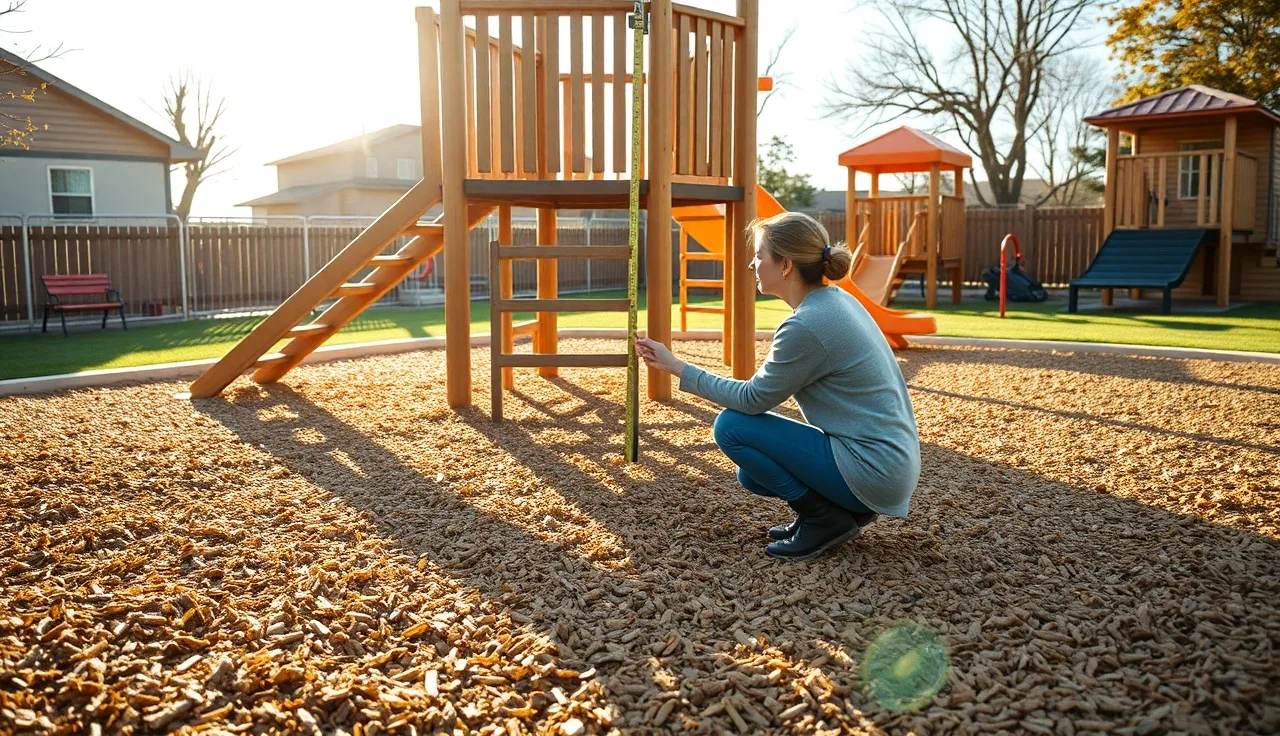
The depth probe. The inspector pushes a rigid measuring rod straight down through the surfacing to the hard base underneath and reads the depth. They do this in several spots: under the highest point of the equipment, at the fall zone perimeter, and in the high-traffic landing areas like the slide exit or in front of swings. Those high-traffic spots compress and migrate, so that's where depth failures almost always turn up [7].
The visual and tactile check. Inspectors scan for voids, bare soil patches, hard spots, and material that's migrated out of the fall zone onto surrounding hard surfaces. A fall zone that's 9 inches deep at the center but 2 inches deep at the slide exit fails.
What inspectors don't do is run ASTM F1292 drop testing on-site. That test needs lab equipment. If you install a unitary rubber surface, you present the manufacturer's ASTM F1292 certificate at the correct thickness, and the inspector verifies thickness with a probe or ruler, not a drop test.
Get cited for insufficient depth and the typical correction window is 30 days, though it varies by state. In most licensing frameworks you can't operate the equipment during that window. If the whole play yard gets cited, the children can't use it until you bring depth into compliance and pass a re-inspection.
A simple maintenance log, where you record monthly depth measurements in the highest-risk spots, is a baseline practice the ChildCareComp compliance toolkit recommends. Inspectors read documented self-monitoring as a sign the problem won't come back.
What does fall zone surfacing actually cost to install and maintain?
Honest answer: cost swings a lot with material, region, and how much area you have to cover. Here's a realistic range based on typical contractor and retail supply pricing as of 2025.
Engineered wood fiber runs roughly $25 to $40 per cubic yard, bulk delivered. Covering a 400 square foot fall zone at 9 inches deep takes about 11 cubic yards, so material alone runs $275 to $440 before delivery or install. Add $150 to $300 for delivery and raking labor on a small residential job. Total initial install for a modest home daycare fall zone lands around $400 to $800.
Pea gravel is cheaper per yard ($15 to $25), but you burn through more of it maintaining depth because it migrates fast. The long-run cost isn't necessarily lower.
Poured-in-place rubber or rubber tiles run $8 to $20 per square foot installed. A 400 square foot fall zone costs $3,200 to $8,000 installed. High upfront, near-zero annual maintenance if it's installed right. For a center with a large play yard, that math can favor rubber over a 10-year horizon.
For loose fill, plan on adding 15 to 25 percent of your original material volume every year to replace what compacts and migrates. Budget roughly $100 to $300 per year for a standard home daycare fall zone.
ADA compliance changes the calculus for centers receiving federal funding or serving children with disabilities. Pea gravel and most loose fills fail ASTM F1951 accessibility testing [8]. If an accessible route to play equipment is required, engineered wood fiber (which passes F1951) or a unitary surface is the practical choice [2].
One more cost most operators ignore until it bites: insurance. Check what your home daycare insurance covers. A playground injury claim on a non-compliant surface is likely to draw a coverage dispute if the surface was a known licensing violation. Center operators should note that daycare liability insurance carriers increasingly ask for surfacing compliance documentation at renewal.
What are the most common fall zone violations found during daycare licensing inspections?
Based on CPSC playground hazard data, National Program for Playground Safety findings, and recurring themes in state licensing inspection reports, these are the violations that show up most [1][5][7]:
1. Insufficient depth in high-traffic areas. The fall zone looks fine on a walk-around, then a probe at the slide exit or under the swing reads 3 to 4 inches instead of 9. This is the single most common deficiency.
2. Material migrated outside the fall zone. Wood chips drift onto the surrounding hard surface or into the grass border. The zone reads as covered but runs thin.
3. Hard objects inside the fall zone. Fence posts, landscaping stones, tree roots, or irrigation heads sitting inside the 6-foot perimeter.
4. Bare dirt or grass used as primary surfacing. Almost always a new-provider mistake. The operator sees soft grass and assumes it qualifies. It doesn't.
5. Fall zone too narrow. The operator measured from the center of the equipment instead of the outer edge. A climbing structure 4 feet wide needs the 6-foot zone to start at the edge, so the protected area actually extends about 10 feet from center on each side.
6. Wrong material at the bottom of a slide. Concrete or decking at the slide exit because someone poured a path there. The exit still needs compliant surfacing.
7. Rubber tiles at the wrong depth or with a cracked surface exposing substrate. Unitary surfaces pass inspection on their ASTM F1292 certification at a set thickness. A cracked or settled tile no longer provides certified protection.
Get ahead of these before your inspection and you skip the stress of a correction order. Walk your play yard once a month with a tape measure and a depth probe. You'll catch 90 percent of them yourself.
Do home daycare outdoor play area rules differ from licensed center rules?
In most states the surfacing depth standards are the same for both, but enforcement runs lighter for home daycares and some states give them a modified scope.
A number of states exempt very small family daycare homes (often those serving fewer than 4 or 6 children) from formal outdoor play area requirements entirely, or let them use public park space instead of an on-site yard. If your state does that, you might not face a formal fall zone inspection at all. But the moment your state requires a licensed play space, the CPSC-based depth rules apply exactly as they do for a center.
States that do inspect home daycare play yards usually run the same checklist a center inspector uses. The real-world difference is that home equipment is almost always residential-grade and stays under 6 feet. So the 6-inch minimum depth technically applies rather than the 9-inch minimum, though many states still write a 9-inch blanket floor. Check your specific licensing regulations.
A common home daycare situation: the operator owns a swing set that sat in the yard before licensing, over existing grass. The inspector cites it on the first visit. The grass has to go under the fall zone. Engineered wood fiber is the fastest fix for most home providers because you can install it yourself over a weekend.
Home daycare outdoor rules also cover fencing, visibility, equipment age limits, and shade. Surfacing is one item on a longer list. Build your outdoor compliance checklist from your state's licensing regulation, not from general internet advice, because the required items vary by state.
How should you document and maintain fall zone compliance between inspections?
Licensing inspections happen once a year in most states, sometimes less often. A fall zone that passes in April can be dangerously thin by September if you let it go. Documentation protects you legally and operationally.
A simple monthly maintenance log should record the date, the measurement location (a few named fixed points like "slide exit," "under swing A," "north perimeter"), the measured depth in inches, any material added, and who did the check. Keep these records at least three years. If a child is injured and litigation follows, a documented maintenance history showing active monitoring is your strongest defense.
Top off on a schedule. Most loose-fill materials need at least one top-off a year, two if you run heavy traffic. Measure in spring before the busy season starts, and again in fall to see what summer depleted.
Keep a copy of your surfacing material's ASTM F1292 test certificate (if you use a manufactured product) or your bulk material invoices showing cubic yardage and material type. When the inspector asks what you installed, show documentation instead of explaining from memory.
Use a professional playground maintenance company for annual inspection and top-off? Get their written report. It documents that a trained person verified depth compliance on a specific date.
Center operators with multiple outdoor zones should keep a simple grid map of the play yard with measurement points labeled. It speeds up the monthly check and keeps you from skipping spots. The ChildCareComp compliance toolkit includes a customizable fall zone inspection log template that meets most state documentation expectations.
Where can you find your state's specific fall zone rules?
The fastest path is your state licensing agency's website. Every state publishes its child care licensing regulations as public records. Search your state name plus "child care licensing regulations" or "child care minimum standards," then find the outdoor or playground section.
The federal Office of Child Care (part of HHS) keeps a listing of state child care licensing contacts and links to state regulations [4]. Child Care Aware of America publishes a yearly licensing study summarizing outdoor space requirements across states, though it doesn't always capture exact depth numbers [5].
The CPSC "Handbook for Public Playground Safety" (Publication 325) is a free PDF on the CPSC website and it's the primary reference document behind most state rules [1]. Reading it takes a few hours. Do it once and you'll understand every inspector you ever meet.
ASTM International sells the F1292 and F1951 standards, and they aren't free. If you install a unitary surface, your manufacturer's documentation references these standards, so you don't need to buy them yourself.
When your state's language is ambiguous, call your licensing consultant and ask, in writing, for the minimum surfacing depth required for the equipment heights you have. Get the answer by email so you have a record of the agency's interpretation. Consultants vary in how well they know playground-specific rules. If an answer looks inconsistent with CPSC guidance, ask them to point you to the exact regulation language.
Frequently asked questions
What is the minimum depth for fall zone surfacing under playground equipment at a daycare?
The CPSC requires at least 6 inches of loose-fill surfacing for equipment up to 5 feet high, 9 inches for equipment up to 7 feet, 11 inches of wood chips (or 9 inches of engineered wood fiber) up to 10 feet, and 12 inches for the tallest equipment. Many state daycare agencies set 9 inches as a blanket minimum for a safety margin. Verify your state's binding number.
Does grass or dirt count as acceptable fall zone surfacing for a licensed daycare?
No. CPSC lists grass and soil as unacceptable primary fall zone surfacing because they compact to near-hard-surface impact levels under regular use. State daycare licensing inspectors will cite bare dirt or grass as a deficiency. You have to replace it with an approved loose-fill or unitary surface material inside the fall zone.
How far does the fall zone extend around daycare playground equipment?
For most stationary equipment the fall zone extends at least 6 feet in every direction from the equipment's outer edge, not its center. For swings, the zone runs forward and backward a distance equal to twice the height of the swing pivot, which can reach 14 to 16 feet each way. Slides need a 6-foot zone from the exit in the direction of travel.
Can I use rubber mulch in my daycare fall zone?
Rubber mulch isn't currently on CPSC's recommended loose-fill list. CPSC has flagged heat buildup and chemical content concerns for recycled rubber mulch products, especially for young children. Engineered wood fiber, pea gravel, and double-shredded bark are the more reliably accepted options. If your state's rules specifically allow rubber mulch, get that confirmation in writing before installing it.
How do daycare licensing inspectors measure fall zone depth?
Inspectors probe the surfacing at multiple points with a rigid measuring rod, pushing it through the material to the hard substrate beneath. They focus on high-wear spots: under swing seats, at slide exits, and around the perimeter of climbing structures. They also check visually for bare spots, migrated material, and hard objects inside the fall zone.
What happens if my daycare fails a fall zone inspection?
You typically get a written correction order with a compliance deadline, often 30 days. During that window the affected equipment or play area is usually closed to children. After you make the fix, you request a re-inspection. Repeated or uncorrected violations can lead to license suspension. Documenting your fix with photos and dated material receipts supports the re-inspection.
Does ADA require specific fall zone surfacing for daycare programs?
ADA doesn't mandate a specific material by name, but programs covered by ADA must provide an accessible route to play equipment. Pea gravel and most loose sand fail ASTM F1951, the accessibility standard for surfaces. Engineered wood fiber and unitary rubber surfaces pass. If your program serves children with disabilities or receives federal funding, this sits on top of the licensing depth requirements.
How often should fall zone surfacing be topped off at a daycare?
At minimum once a year, before the heavy-use season. High-traffic daycares with daily outdoor use should check depth monthly and top off twice a year. Loose-fill materials compact and migrate, so a zone that started at 9 inches can drop to 5 inches within a single season without maintenance. A monthly depth-check log documents that you're monitoring proactively.
Is engineered wood fiber better than pea gravel for a daycare fall zone?
For most operators, yes. Engineered wood fiber meets ASTM F1951 accessibility requirements, compacts less than pea gravel, and holds up at the 9-inch standard depth to 10 feet of equipment height. Pea gravel migrates fast under active play, needs more frequent top-off, and fails the accessibility standard. EWF's higher initial cost is usually offset by lower maintenance.
Do home daycares face the same fall zone rules as child care centers?
In most states, yes, if the home daycare is required to have a licensed outdoor play space. Some states exempt very small family daycare homes from formal outdoor requirements, and some allow use of a nearby public park instead. When a home play yard is inspected, the same CPSC-based depth and material standards apply. Check your state's family daycare home regulations specifically, since they're often a separate document from center rules.
What CPSC or ASTM documents govern daycare fall zone surfacing?
The primary documents are CPSC Publication 325 (Handbook for Public Playground Safety), ASTM F1292 (impact attenuation of surfacing materials), and ASTM F1951 (accessibility of surfacing). Most state licensing rules either cite CPSC 325 directly or set numeric rules derived from it. ASTM F1292 certification matters most if you install manufactured rubber surfacing.
Can I use sand in my daycare fall zone?
Sand is an approved loose-fill material under CPSC guidance but comes with real limits. It compacts when wet, isn't recommended for equipment above 7 feet in most contexts, fails ADA accessibility under ASTM F1951, and needs frequent maintenance to hold required depth. Many licensing consultants advise against it for licensed daycares because the maintenance burden raises the risk of failing a routine inspection.
What does installed fall zone surfacing typically cost for a small daycare?
Engineered wood fiber for a 400 square foot fall zone at 9 inches deep runs roughly $400 to $800 in material and basic installation. Pea gravel is cheaper per yard but migrates faster. Poured-in-place rubber or rubber tiles run $3,200 to $8,000 for the same area but need almost no ongoing depth maintenance. Annual top-off for loose fill adds $100 to $300 a year for a typical home daycare-scale zone.
Does CCDF require specific fall zone surfacing depths?
CCDF itself doesn't specify surfacing depths. Federal CCDF rules require states receiving funds to keep health and safety standards for licensed childcare that include outdoor play space, but the specific depth and material requirements live in each state's licensing regulations. The surfacing numbers you're held to come from your state rules, which are in turn shaped by CPSC guidance.
Sources
- U.S. Consumer Product Safety Commission, Handbook for Public Playground Safety (Publication 325): Fall zone must extend at least 6 feet from equipment perimeter; minimum loose-fill depths range from 6 inches at 5 ft fall height to 12 inches at 11 ft fall height; grass and soil are not acceptable primary fall zone surfacing
- ASTM International, Standards F1292 and F1951 (impact attenuation and accessibility of playground surfacing): F1292 sets maximum 200 G peak and HIC of 1,000 for surfacing materials; F1951 governs accessibility of surfaces for people with disabilities; engineered wood fiber passes F1951, pea gravel does not
- Texas Health and Human Services, Minimum Standards for Child-Care Centers: Texas sets a 9-inch minimum depth for loose-fill surfacing in fall zones at licensed child care centers
- U.S. Department of Health and Human Services, Office of Child Care, CCDF Program: CCDF requires states receiving funds to maintain health and safety requirements for licensed childcare including outdoor play space, though specific surfacing depths are set in state rules
- Child Care Aware of America, Licensing Study (annual state licensing research): Majority of states reference CPSC playground safety standards in licensed childcare regulations; outdoor space requirements vary by state
- U.S. Consumer Product Safety Commission, Playground Safety (CPSC Safety Education Center): Swing use zones extend forward and backward a distance equal to twice the height of the swing pivot point from the pivot
- National Program for Playground Safety, University of Northern Iowa: High-traffic areas such as slide exits and swing landing zones are the most common locations for insufficient depth violations in playground inspections
- U.S. Access Board, ADA Standards for Accessible Design (play areas): ADA requires accessible routes to play equipment; surfacing must meet ASTM F1951 for programs covered by ADA
- Centers for Disease Control and Prevention, Playground Injuries: Playground injuries result in approximately 200,000 emergency department visits per year for children in the U.S.; fall-related injuries are the most common type
- U.S. Department of Health and Human Services, Child Care and Development Fund Final Rule (45 CFR Part 98): CCDF final rule requires states to establish health and safety requirements addressing prevention of and response to emergencies due to injury in child care settings