Last updated 2026-07-09
TL;DR
Fire inspectors check that daycare exits are clear, smoke and CO detectors work, extinguishers carry a current tag, sprinklers function, and drill logs are complete. Most states inspect annually before license renewal. One failed item, a blocked exit or an overdue extinguisher tag, can close you the same day. This checklist covers federal floor requirements plus state rules for Connecticut and Tennessee.
What does a fire inspector actually look for in a daycare?
A fire inspector works from a checklist built out of two rulebooks: your state fire code (usually based on the NFPA 101 Life Safety Code) and your state child care licensing regulations [1]. The two overlap in places and conflict in others. You have to satisfy both.
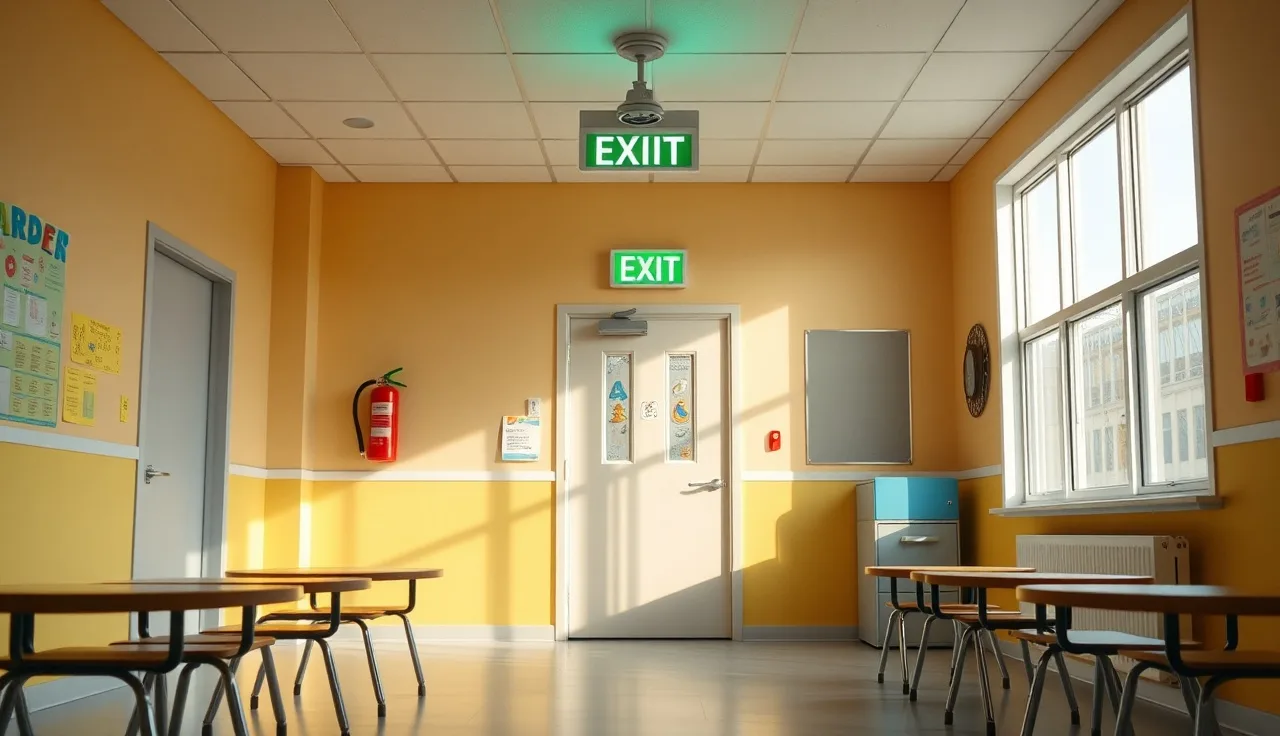
The core items barely change from state to state. Exits stay clear, marked, and lit. Smoke detectors go in every room where children sleep and in the corridors. Carbon monoxide detectors are required anywhere you have a gas appliance or an attached garage. Fire extinguishers have to be the right type, mounted at the right height, and serviced within the last 12 months. Sprinkler systems, where the code requires them, carry a current inspection tag.
Then there's the paperwork. The inspector wants a drill log showing you ran the required number of drills over the past year, each entry stamped with a date, a time, and a headcount of children and staff. A thin or missing log fails the paper portion even if your building is spotless.
Here's what many operators miss. The inspector cares more about how the building is being used on inspection day than what it's rated for. A closet crammed with donated supplies and blocking a secondary exit is a violation, even though the closet itself is perfectly legal. Blocked egress is the single most common citable item I see turn up in state licensing databases.
What are the federal baseline requirements for daycare fire safety?
There is no single federal fire inspection standard for daycares. Federal money still creates real requirements. Programs that take Child Care and Development Fund (CCDF) subsidies must meet health and safety standards that each state defines, and those standards have to include fire safety [2]. The CCDF final rule (45 CFR Part 98) tells lead agencies to set health and safety requirements covering "building and physical premises safety" and to inspect, or require inspection of, every provider receiving subsidies [2].
Most states build their fire code on NFPA 101, either by adopting it by reference or by rewriting its numbers into their own code. NFPA 101 Chapter 16 covers new childcare occupancies and Chapter 17 covers existing ones [1]. The split matters. Existing buildings get more time to comply and slightly looser retrofit rules in a few areas.
Here are the NFPA 101 thresholds that shape most childcare inspections:
| Requirement | NFPA 101 Standard |
|---|---|
| Smoke detectors | Required in every room used for sleeping; in corridors |
| Emergency lighting | Required, must last 1.5 hours on battery backup |
| Exit signage | Required at every exit and exit access door |
| Sprinkler system | Required in buildings 3+ stories, often required in all new childcare builds |
| Maximum travel distance to exit | 200 ft (sprinklered), 150 ft (non-sprinklered) |
| Drills | Minimum 1 per month when in session |
| Door hardware | Egress doors must open without a key or special knowledge |
Treat these as floors, not ceilings. Your state may ask for more [1].
What is a complete fire inspection checklist for a daycare center?
Print this and walk your building before the inspector shows up. Every item here matches a citable violation on at least one state's inspection form.
Exits and egress
- All exit doors open from the inside without a key, tool, or special knowledge [1]
- Exit doors swing outward in the direction of travel for any room holding 50 or more occupants
- Exit corridors are at least 28 inches wide (some states require 36 inches for licensed childcare)
- All exit paths are clear: no furniture, stored materials, or equipment in the route
- Exit signs are illuminated and visible from 200 feet in normal light
- Emergency lighting activates on power loss and stays on for 90 minutes
- Every exterior exit door leads directly outside or to a path of egress
Detection and alarm
- Smoke detectors in every room children occupy, in every corridor, and in every room used for sleeping [3]
- CO detectors within 15 feet of every sleeping area and near any gas appliance (varies by state; check yours)
- Interconnected alarms: when one sounds, all sound
- Detectors tested and documented within the required interval (most states annually; NFPA recommends monthly self-testing)
- Batteries replaced on a documented schedule; no low-battery chirps
- Fire alarm pull stations present and unobstructed at exits
Fire suppression
- At least one 2A:10B:C extinguisher (multi-purpose dry chemical) per 3,000 sq ft, placed so no one travels more than 75 feet to reach one [1]
- Extinguisher service tag shows an inspection within the past 12 months by a licensed contractor
- Extinguisher mounted between 3.5 and 5 feet off the floor (handle height)
- Sprinkler system, if present, inspected quarterly (wet) or annually (dry) with tags current
- No sprinkler heads painted, covered, or within 18 inches of stored materials
Drill documentation
- Drill log kept on-site and handed over on request
- Drills run at the frequency your state requires (monthly in most states when children are present) [3]
- Each entry includes date, time, number of children evacuated, number of staff, problems noted, and total evacuation time
- Drills varied by time of day and scenario (different exits, simulated blocked routes)
Heating, electrical, and storage
- Space heaters banned in child-occupied rooms in most states; check your licensing rules
- Electrical panels clear with 36 inches open in front
- No open junction boxes; all outlets covered
- Flammable liquids (cleaning supplies, art materials) locked away, out of child-accessible areas
- No combustible storage within 18 inches of the ceiling in sprinklered buildings; 24 inches in non-sprinklered
- Cooking areas meet hood and suppression requirements if you cook for more than a set number of people
Building-specific items
- Fireplace or wood stove: screen in place, hearth clear, ash stored outside
- Basement or below-grade rooms used for children: a second means of egress present (a window doesn't always count; check your state code)
- Kitchen: grease filters clean, suppression system current
- Boiler room: door is self-closing and rated, boiler has a current inspection
What does a fire inspection checklist for home daycare look like?
Home daycare fire inspections are lighter than center inspections in most states. They aren't optional if your state requires them for licensing. The big difference is occupancy load. A home with 6 children under one provider runs different egress math than a center serving 80 kids.
For a home daycare, the checklist usually centers on:
- Working smoke detectors on every level, including the basement, and inside each bedroom [3]
- CO detector within 15 feet of each sleeping area (required in most states with revised codes)
- At least one fire extinguisher in the kitchen, serviced within 12 months
- Two usable exits from each occupied room (a window sized for adult egress often counts; confirm with your inspector)
- A written evacuation plan posted somewhere visible
- Drill log: many states make even home providers run 2 to 4 drills a year and log them
- No keyed deadbolt on the primary exit door
- Sleeping rooms for infants and toddlers on the same level as the main exit, or a sprinkler system in the home (some states require this for any home caring for children under 2)
Here's the one thing home providers forget: the garage. If your attached garage has a door into the childcare area, that door has to be fire-rated (usually a 20-minute rated solid wood or steel door) and self-closing. A hollow-core interior door between a garage and a room where children sit is a violation in every state I've reviewed.
Home daycare insurance policies sometimes ask you for proof of a passed fire inspection. Read your policy before your first inspection so you know what it demands.
What does the CT daycare inspection checklist require?
Connecticut runs a two-track system. The Office of Early Childhood (OEC) handles licensing inspections, and local fire marshals conduct fire safety inspections on their own. Both have to pass before a license issues or renews [4].
Connecticut's fire safety requirements for licensed childcare are in the Connecticut State Fire Prevention Code, which adopts NFPA 101 with Connecticut amendments [4]. The state-specific pieces:
- Sprinklers: Connecticut requires automatic sprinkler systems in all new childcare centers, whatever the size. Existing centers retrofit on a schedule phased in over many years; confirm your building's status with your local fire marshal.
- Drills: Connecticut licensing requires at least one fire drill per month while children are in care. The record has to be ready for both the OEC licensing inspector and the fire marshal [5].
- Sleep safety: For programs caring for children under 2 who nap on-site, Connecticut OEC wants sleeping areas on the same floor as an exit to grade, or a sprinkler system in place.
- Door hardware: Connecticut follows NFPA 101 on locking hardware and also requires that childproof mechanisms on exit doors delay egress by no more than 3 seconds for trained staff.
- Documentation: Connecticut fire marshals ask for the most recent extinguisher service tag, the current sprinkler inspection record, the past 12 months of drill logs, and the detector testing log.
Connecticut local fire marshals vary a lot. Some walk through in 20 minutes. Others take 90 minutes and open every closet. Call your local marshal's office before the first inspection and ask which form they use. Most will email it to you.
What does the fire marshal inspection checklist for TN daycares require?
Tennessee licensed childcare centers and homes go through two separate inspection tracks. The Tennessee Department of Human Services (TDHS) handles licensing, and the State Fire Marshal's Office (or a local authority having jurisdiction) handles fire inspections [6]. Both have to be current for a license to stay in good standing.
Tennessee's childcare fire safety rules live in Tennessee Code Annotated Title 68 and the State Fire Marshal's rules, which reference NFPA 101 [6]. The state-specific items operators trip over:
- Drills: Tennessee requires at least one fire drill per month when children are present. The log has to include date, time, the number of children and staff, and the total evacuation time [6].
- Extinguisher type: Tennessee fire code specifies Type ABC (multi-purpose dry chemical) extinguishers in childcare settings, inspected annually by a licensed company. The tag stays visible and current.
- Sleeping rooms: Tennessee requires a sprinkler system for any infant or toddler sleep room that isn't on the grade-exit level. This catches basement nap rooms operators assume are fine.
- Exit lighting: All exit lights get a brief monthly test and a 90-minute battery test annually, with records kept on-site.
- Licensed center vs. home: Small family home providers (caring for 1 to 6 children in Tennessee) may face a lighter inspection, but TDHS still requires a fire safety self-certification and, in many counties, local fire marshal verification.
Tennessee's State Fire Marshal's Office publishes guidance for childcare providers and takes pre-inspection consultation calls. I'd make that call for any new provider. They tend to be helpful before the license is issued, and it costs you nothing.
How often do daycares get fire inspections?
Most states inspect daycares once a year, tied to license renewal. Some run a separate inspection for initial licensing and then annual renewals after that. A handful accept a fire marshal's letter of compliance in place of a state-conducted inspection if it was done within the past year [7].
Child Care Aware of America's annual state fact sheets show real variation in how states schedule these, but the pattern holds: at least annual for centers, sometimes every two years for licensed home providers [7].
Beyond the scheduled visit, fire marshals run complaint-driven and random inspections. A neighbor complaint about a blocked exit, a smoke detector chirping loud enough to hear from the sidewalk, or a report from a fired employee can all trigger an unannounced visit. So keep the facility ready as if an inspector arrives tomorrow, because in some states that's literally possible.
Drill frequency is almost universal: one per month while children are in care. Some states want a certain number of drills during nap time or meal service, since those two periods take longest to evacuate. Tennessee and Connecticut both require monthly drills [5][6].
Some daycare liability insurance carriers make a passed annual fire inspection a policy condition. Miss the inspection and you can void coverage at the exact moment you'd need it.
What happens if a daycare fails a fire inspection?
The consequences run from a correction notice with a 30-day cure period all the way to same-day license suspension, depending on how bad the violation is.
Most states sort fire violations by risk level. A blocked exit, a dead smoke detector in a sleeping room, or a missing sprinkler head is usually a Class 1 or "immediate jeopardy" finding, and those can close you the same day. An overdue extinguisher tag or a thin drill log is usually a lower-priority finding that triggers a follow-up inspection within 30 to 90 days.
A few things to keep in mind:
- The fire marshal and the licensing agency talk to each other. A fire marshal finding doesn't sit quietly in the fire department's files. It flows to your licensing office.
- Repeated minor violations across inspections stack up. A warning letter becomes a license condition, then a fine, then a revocation.
- If children are present when an immediate jeopardy violation surfaces, the marshal can order the building evacuated and the children sent home. Parents get notified. That's a reputation hit as much as a compliance hit.
The three fastest ways to fail are blocked exits, non-functioning detectors, and missing drill logs. Those three make up the majority of actionable findings in the state licensing reports I've reviewed. Fix them first.
How should you prepare for a daycare fire inspection in advance?
Run your own inspection six to eight weeks before the annual due date, using the same checklist your state fire marshal uses. Most fire marshal offices publish it. If yours doesn't, ask for a copy when you call to schedule.
A few steps that save real time and stress:
Schedule extinguisher service early. Licensed contractors get slammed in spring, which is when many daycare licenses renew. Call in February or March. The service tag has to show the inspection month and year, and a tag from 13 months ago fails.
Test every detector. Press the button. Replace any detector more than 10 years old; NFPA 72 requires replacement at that age because sensor reliability degrades [8]. Write the replacement date inside the housing in marker.
Review your drill log. Count the entries for the past 12 months. Short? Run extra drills before the inspection. Confirm each entry has every field: date, time, children headcount, staff headcount, evacuation time, and notes.
Walk every exit path. Do it at 7:00 AM before setup, not at noon when everything looks tidy. Coats, backpacks, strollers, and donated equipment pile up near exits and nobody notices until the inspector does.
Check your documentation binder. Keep one binder holding your current license, most recent fire inspection report, extinguisher service tags, sprinkler inspection records, detector testing logs, drill logs, and evacuation plan. Hand it to the inspector when they walk in. It signals competence in the first thirty seconds.
ChildCareComp's compliance toolkit has a pre-inspection walkthrough form and a drill log template you can print and use before your next inspection, which takes some guesswork out of building that binder.
One more overlap worth knowing. Daycare cleaning routines and fire safety run into each other more than operators expect. Grease on kitchen hood filters, flammable cleaning supplies stored wrong, and lint packed around dryer vents are all fire hazards an inspector will cite.
What fire safety training do daycare staff need?
Staff fire training is a licensing requirement, more than a smart practice. Most states require every staff member to get fire safety training during new employee orientation and then again on a recurring schedule, commonly once a year.
Based on CCDF health and safety requirements and state licensing rules, that training has to cover [2][3]:
- How to operate a fire extinguisher (the PASS method: Pull, Aim, Squeeze, Sweep)
- The evacuation routes for each area of the building
- Who owns the attendance roster and confirms every child is accounted for
- Procedures for children who need mobility assistance
- How to call 911 and what to report
- Where to gather after evacuation and how to keep children calm and together
Training records go on file. The inspector may ask to see them. "We trained everyone verbally" does not satisfy a documentation requirement.
If you care for infants, the evacuation plan has to spell out how infants get moved. An evacuation crib on wheels that holds four infants is a common fix for larger infant rooms. Some states name the evacuation equipment required for infant rooms; Tennessee and Connecticut both address this in their licensing rules [5][6].
Staff turnover is where training compliance falls apart. When you hire a new teacher, run fire safety orientation in week one and get it signed by both the employee and the director that same day.
Are there fire safety differences between licensed home daycares and daycare centers?
Yes, and the gap is big enough to change your budget and your physical setup.
Centers sit in commercial or institutional buildings with occupancy classifications that trigger automatic sprinkler requirements, emergency lighting, and multi-exit mandates most single-family homes never face. A center in a standalone building built after 2012 will almost certainly need a full sprinkler system in any state that has adopted a recent NFPA 101 edition.
Home daycares usually run off residential fire codes as their baseline, with childcare-specific additions layered on by the licensing agency. That means no sprinkler requirement in most states for family home daycares caring for fewer than 6 or 7 children, but still a requirement for interconnected smoke detectors, CO detectors, and documented drills.
The line blurs for group family home daycares, which usually care for 7 to 12 children. Many states put these programs under commercial or institutional fire code instead of residential. If you're moving from a family home to a group home license, call your state fire marshal before you start. The retrofit costs can be steep.
One practical note: home daycare fire inspections are sometimes done by the local fire department rather than a state-level marshal. The local inspector may use a checklist that differs from the state's model. Get the local form. Call the fire station covering your address and ask for it.
Frequently asked questions
How many fire drills does a daycare need to conduct per year?
Most states require one fire drill per month while children are in care, which works out to roughly 10 to 12 drills per year depending on your operating schedule. Connecticut and Tennessee both mandate monthly drills. Some states add that a set number of drills happen during nap time or mealtimes, since evacuating during those activities takes longer. Log every drill with date, time, headcount, and total evacuation time.
Does a home daycare need a fire inspection to get licensed?
In most states, yes. The requirement varies: some states require a fire marshal inspection before initial licensing; others accept a self-certification checklist for small family home programs and then run periodic inspections. Programs receiving CCDF subsidy funding must meet state health and safety standards that include fire safety inspection. Check your state licensing office's pre-licensing packet, where the fire inspection requirement and form are usually listed.
What type of fire extinguisher is required in a daycare?
Most states and NFPA 101 require a multi-purpose dry chemical extinguisher rated at minimum 2A:10B:C. It has to be serviced annually by a licensed contractor, with the service tag visible and current. Extinguishers mount between 3.5 and 5 feet off the floor (measured to the handle) and go where no one in the building travels more than 75 feet to reach one. Kitchens may also need a Class K extinguisher if commercial cooking equipment is present.
What happens if a smoke detector is missing or broken during a daycare fire inspection?
A non-functional or missing smoke detector in any child-occupied room, corridor, or sleeping area is usually a serious or immediate jeopardy finding. The fire marshal can require correction before children return to that space. A chirping low-battery detector may get a same-day fix and re-check, but document the correction. Replace any detector older than 10 years no matter what a button test shows.
Can a daycare use a padlock or keyed deadbolt on an exit door?
No. NFPA 101 and every state fire code I'm aware of require egress doors to open from the inside without a key, tool, or special knowledge. That rules out keyed deadbolts needing a key from inside. Some childproof hardware is allowed if it releases within 3 seconds for trained staff and needs no key. Padlocked or double-keyed exit doors are among the most serious violations an inspector can cite.
What is on a fire marshal inspection checklist specifically for Tennessee daycares?
Tennessee fire marshals check clear and functional exits, smoke and CO detectors in all required spots, ABC fire extinguishers with current annual service tags, monthly drill logs with full documentation, sprinkler systems in any sleeping room not on the grade-exit level, and emergency lighting with current test records. They reference NFPA 101 as adopted in Tennessee's fire code and coordinate with TDHS on findings that affect childcare licensing status.
What Connecticut daycare fire inspection items do operators most commonly fail?
Connecticut operators most commonly fail on incomplete or missing drill logs, sprinkler systems without a current inspection, blocked secondary exits, and smoke detector gaps in corridors connecting child-occupied rooms. The OEC and local fire marshals both review fire documentation during licensing inspections. The monthly drill requirement gets strict enforcement; a log showing 8 drills when 12 months of operation requires 12 is a citable deficiency.
How far in advance should I schedule a fire extinguisher inspection for my daycare?
Schedule 6 to 8 weeks before your license renewal date. Licensed fire extinguisher contractors are busiest in spring, which is when many childcare licenses renew. The service tag has to show the month and year of the most recent inspection. An extinguisher tagged 13 months ago fails even if the charge is full. Some operators book a standing annual appointment with the same contractor every February to stay ahead of the deadline.
Do daycare fire safety rules apply to outdoor play areas?
Generally no for the hardware items like extinguishers and detectors, but the evacuation plan must include the outdoor assembly area. The assembly point sits a safe distance from the building (typically at least 100 feet, away from the parking lot and utilities), is designated in writing, and gets practiced in every drill. Inspectors will ask where your assembly point is and whether staff know it. Some states require it to be marked or mapped in your posted plan.
Does my daycare's evacuation plan need to be posted, and where?
Yes. Most states require the evacuation plan posted in a visible spot in each room or area used by children. It has to show the room's location, primary and secondary exit routes, and the assembly area. Keep it simple enough that a substitute teacher who has never been in the building can follow it under stress. Update and re-post the plan any time you change room assignments, add exits, or move your assembly point.
What documentation should I have ready when the fire inspector arrives?
Have a binder ready with the current year's drill log, the most recent extinguisher service tag or invoice, sprinkler inspection records if applicable, smoke and CO detector testing logs, your posted evacuation plan, and any prior inspection reports with corrective actions completed. Handing this binder to the inspector at the start shows compliance before they walk a single room, and it cuts the inspection time down sharply.
Are there fire safety grants or funding available to help daycares meet inspection requirements?
Some states offer CCDF quality improvement funds usable for health and safety upgrades including fire safety equipment. Child Care Aware of America can point you to your state's Child Care Resource and Referral agency, which tracks available grants. Some local fire departments run free smoke and CO detector programs for homes that may extend to home daycare providers. FEMA's Assistance to Firefighters grant program sometimes funds community safety equipment but rarely reaches individual operators.
What is the difference between a fire inspection and a licensing inspection at a daycare?
They're separate events run by different agencies. The fire inspection comes from the state fire marshal or local fire authority and looks only at fire and life safety code: exits, detectors, extinguishers, sprinklers, drills. The licensing inspection comes from your state's childcare regulatory agency and covers everything from staff ratios to nutrition to documentation. Both have to pass. Fire inspection results are usually shared with the licensing agency.
Sources
- NFPA, Life Safety Code 101, Chapters 16-17 (Childcare Occupancies): NFPA 101 establishes baseline requirements for exits, smoke detectors, sprinklers, extinguisher placement, and drill frequency in childcare occupancies, including maximum travel distance to exits of 200 ft (sprinklered) or 150 ft (non-sprinklered)
- U.S. Department of Health and Human Services, Administration for Children and Families, CCDF Final Rule 45 CFR Part 98: CCDF requires lead agencies to establish health and safety requirements including building and physical premises safety, and to inspect or require inspection of providers receiving subsidies
- U.S. Consumer Product Safety Commission, Smoke Alarms in U.S. Home Fires: Working smoke alarms are required in every room used for sleeping; interconnected alarms required so that when one sounds, all sound
- Connecticut Office of Early Childhood, Child Care Licensing Regulations: Connecticut OEC handles licensing inspections and local fire marshals conduct independent fire safety inspections; both must be passed before a license issues or renews
- Connecticut State Fire Prevention Code, adopted NFPA 101 with Connecticut amendments: Connecticut requires at least one fire drill per month while children are in care, and drill records must be available to both the OEC licensing inspector and the fire marshal
- Tennessee Department of Human Services, Child Care Licensing Rules, and Tennessee State Fire Marshal's Office: Tennessee requires at least one fire drill per month when children are present, drill logs with date, time, number of children and staff, and total evacuation time; fire marshal inspections required for licensed childcare
- Child Care Aware of America, Child Care in America State Fact Sheets: Most states require annual fire inspections tied to license renewal; some allow a fire marshal letter of compliance to substitute for a state-conducted inspection if completed within the past year
- NFPA 72, National Fire Alarm and Signaling Code: NFPA 72 requires smoke detector replacement at 10 years from manufacture date because sensor reliability degrades over time; monthly self-testing recommended
- U.S. Fire Administration / FEMA, Fire Safety in Child Care Centers: Exit signs must be illuminated and visible from 200 feet in normal light; emergency lighting must activate on power loss and remain on for 90 minutes (1.5 hours)
- Administration for Children and Families, Office of Child Care, Health and Safety Requirements: CCDF health and safety requirements mandate staff training in fire safety as part of new employee orientation and at recurring intervals, with records kept on file