North Carolina Childcare Licensing Requirements: Complete Guide
TL;DR
- North Carolina childcare licensing is managed by the Division of Child Development and Early Education (DCDEE).
- Infant staff-to-child ratio is 1:5, toddler is 1:6, preschool is 1:11.
- Centers need at least 75 sq ft of indoor space and 95 sq ft of outdoor space per child.
- Directors must complete at least 100 hours of approved training.
- Licenses must be renewed every 3 years.
Overview of North Carolina Childcare Licensing
If you operate a childcare center in North Carolina, you need a license from the Division of Child Development and Early Education. The DCDEE sets the rules for staff qualifications, facility standards, health and safety, and child supervision. Every center, whether it serves 10 children or 200, falls under these regulations.
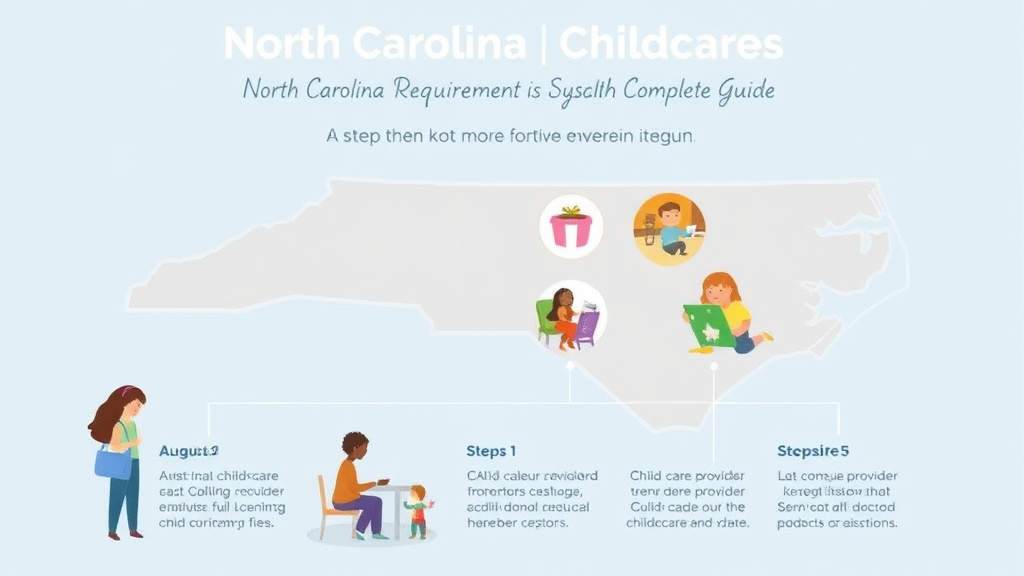
The licensing process in North Carolina involves an initial application, background checks for all staff, a facility inspection, and ongoing compliance monitoring. Centers that fail to meet standards can face citations, fines, or license revocation. The best approach is to understand the requirements before you open your doors and to build systems that keep you compliant year after year.
Licensing is not a one-time event. Once you receive your license, you are subject to regular inspections, both announced and unannounced. The DCDEE will verify that you continue to meet every standard throughout the life of your license. Any changes to your operations, facility, or staffing must be reported and may require a license modification.
This guide covers the key requirements you need to know. For a deeper look at inspections, see North Dakota Childcare Licensing Requirements: Complete Guide.
Staff-to-Child Ratios in North Carolina
Ratio requirements are one of the most commonly cited areas during inspections. North Carolina sets specific ratios based on the age of children in care. You must maintain these ratios at all times, including during outdoor play, meals, and transitions between activities.
| Age Group | Staff-to-Child Ratio | Maximum Group Size |
|---|---|---|
| Infants (0 to 12 months) | 1:5 | 10 |
| Toddlers (12 to 36 months) | 1:6 | 12 |
| Preschool (3 to 5 years) | 1:11 | 22 |
| School-Age (5+ years) | 1:18 | 36 |
When you have mixed-age groups, you must use the ratio for the youngest child in the group. Nap time does not change ratio requirements. Staff on break who are out of the room do not count toward the ratio. For more on ratio compliance, see Infant Staff-to-Child Ratios by State.
Ratio violations happen most often during the first and last hours of the day, during staff breaks, and during transitions from indoor to outdoor play. Build your staffing schedule so that ratios are covered even during these vulnerable periods. Assign a floater who can step into any room when needed. Track ratios in real time, either on a whiteboard or through a compliance tool like ChildCareComp.
If an inspector arrives and finds you out of ratio in any room, even by one child, you will receive a citation. Repeated ratio violations can escalate to fines and probationary license status. The cost of scheduling an extra staff member is far less than the cost of a violation.
Facility and Space Requirements
North Carolina requires a minimum of 75 square feet of usable indoor space per child. This does not include hallways, bathrooms, kitchens, or storage areas. Only spaces where children actually play, eat, and participate in activities count toward the square footage calculation. Outdoor play space must provide at least 95 square feet per child and must be fenced with a barrier at least 4 feet high.
Your facility must pass fire, health, and building inspections before you receive a license. Fire extinguishers, smoke detectors, and carbon monoxide detectors are required on every floor. Emergency exits must be clearly marked and unobstructed at all times. Exit signs must be illuminated, and evacuation routes must be posted in every classroom.
| Requirement | North Carolina Standard |
|---|---|
| Indoor space per child | 75 sq ft minimum |
| Outdoor space per child | 95 sq ft minimum |
| Fence height | 4 ft minimum |
| Bathroom ratio | 1 toilet per 11 children |
| Water temperature | Not to exceed 120 degrees F |
| Indoor temperature | 68 to 75 degrees F |
Cribs and cots must meet current CPSC standards. Nap areas need at least 2 feet of spacing between each sleeping surface. Cribs must have firm, flat mattresses with fitted sheets only. No blankets, pillows, bumper pads, or stuffed animals are allowed in cribs for infants. Drop-side cribs are prohibited.
Your outdoor play area must be inspected regularly for hazards. Check fencing for gaps, broken slats, and sharp edges. Verify that playground surfacing material is at the correct depth under all climbing equipment. Remove any standing water, broken glass, animal waste, or poisonous plants. Shade must be available in the outdoor area, either from structures or from natural coverage. For full facility standards, check Playground Safety Standards for Childcare Centers.
Director and Staff Qualifications
In North Carolina, childcare center directors must hold at least a CDA credential or an associate degree in early childhood education. Some programs require a bachelor's degree. Directors need a minimum of 100 clock hours of approved training before assuming the role, plus 23 hours of continuing education each year.
Lead teachers must have at least a CDA or equivalent credential. Assistant teachers must be at least 18 years old and complete orientation training within 90 days of hire. All staff, including substitutes and volunteers who have unsupervised access to children, must pass background checks through the DCDEE.
Background checks include a state criminal history check, a sex offender registry check, and a child abuse and neglect registry check. FBI fingerprinting is also required. These must be completed before the staff member begins working with children. No employee may have unsupervised contact with children until all background check results have been received and cleared.
Staff qualifications are verified during every licensing inspection. The inspector will pull staff files and check that credentials are current, background checks are on file, and training hours are documented. Missing or expired credentials are one of the most common citations. Set up a tracking system that alerts you at least 60 days before any certification or credential expires.
For details on background check procedures, see Childcare Background Check Requirements by State.
Health, Safety, and Record Keeping
Every child enrolled in a licensed North Carolina childcare center must have a current immunization record and a health assessment on file. The health assessment must be completed by a licensed physician within 30 days of enrollment. Immunization records must be updated whenever the child receives new vaccinations. Centers must track which children are due for immunizations and notify parents when updates are needed.
Centers must maintain daily attendance records, incident reports, medication administration logs, and emergency contact information for each child. Attendance records must include sign-in and sign-out times with the signature of the person dropping off and picking up. Only individuals listed on the authorized pickup list may take a child from the center. Staff must verify identification for anyone they do not recognize.
Staff must hold current CPR and first aid certifications. At least one staff member certified in pediatric CPR and first aid must be present at all times, including during outdoor play and field trips. Medication can only be administered with written parental authorization, and every dose must be logged with the time, amount, and staff member who administered it. Medications must be stored in a locked container out of children's reach.
Fire drills must be conducted monthly. Severe weather drills are required at least twice per year. All drills must be documented with the date, time, number of children and staff participating, the evacuation route used, and total evacuation time. Post evacuation plans in every room at adult and child eye level. First aid kits must be stocked and accessible in every classroom and in the outdoor play area. Check kits monthly and replace expired items immediately.
For more on emergency planning, see Childcare Emergency Procedures.
License Application and Renewal
To apply for a childcare license in North Carolina, you must submit an application to the Division of Child Development and Early Education, pay the required fee, and pass all pre-licensing inspections. The application process typically takes 60 to 120 days, depending on how quickly you complete the required steps. Incomplete applications are the most common cause of delays.
Your application package must include the completed application form, a floor plan showing room dimensions and exits, proof of zoning approval from your local government, documentation of your educational credentials, background check authorization forms for all staff, evidence of liability insurance, and current fire and health inspection reports.
Licenses in North Carolina must be renewed every 3 years. The renewal process includes submitting updated background checks for any new staff, paying the renewal fee, and passing an on-site inspection. Centers with a history of violations may face additional scrutiny during renewal. Start the renewal process at least 90 days before your license expires to avoid any gaps.
If your license lapses, you cannot legally operate until it is renewed. Operating without a valid license can result in fines, legal action, and difficulty obtaining a new license in the future. Post your current license in a visible location near your main entrance. If parents or the public ask to see your license, you must provide access. For a step-by-step application walkthrough, see South Carolina Childcare Licensing Requirements: Complete Guide.
Related Articles
- North Dakota Childcare Licensing Requirements: Complete Guide
- South Carolina Childcare Licensing Requirements: Complete Guide
- Alabama Childcare Licensing Requirements: Complete Guide
Record Retention and Audit Trails
Keeping thorough records is not optional in childcare licensing. Every state requires that specific documents be retained for a set number of years, even after a child leaves your program or a staff member moves on. These retention periods typically range from three to seven years, depending on the document type and your state's rules.
Children's enrollment files, including emergency contacts, health records, immunization documentation, and attendance logs, must be kept for the full retention period. Staff files, including background check results, training certificates, and employment records, have similar requirements. Operational records like fire drill logs, incident reports, and medication administration logs must also be retained.
Organize your archived records in a way that allows you to retrieve them if an auditor, inspector, or legal proceeding requires them. Many centers maintain digital copies alongside physical files as a backup. ChildCareComp provides secure digital storage with automatic retention tracking so you never accidentally purge records before the retention period ends.
During inspections, auditors may ask to see records from previous years. Having them organized and accessible demonstrates professionalism and makes the review process faster for everyone involved. Centers that cannot produce requested records face citations even if the underlying compliance was solid at the time.
Enrollment Policies and Parent Communication
State licensing requires specific enrollment procedures and parent communication protocols. Before a child can attend your program, you must have a completed enrollment packet on file that includes emergency contacts, health information, immunization records, authorized pickup persons, allergy information, and signed acknowledgment of your center's policies.
Parents must receive written copies of your key policies at enrollment, including your illness exclusion policy, discipline policy, medication administration policy, emergency procedures, and payment terms. Many states require that parents sign acknowledging receipt of these documents, and those signed forms must be kept in the child's file.
Ongoing communication with parents is also regulated. You must notify parents of any injury to their child on the day it occurs. Changes to your policies must be communicated in writing before they take effect. And if your center receives a licensing violation, some states require that parents be notified, depending on the severity of the violation.
Strong parent communication goes beyond regulatory requirements. Centers that keep parents well-informed about their child's day, about program changes, and about licensing matters build trust that supports enrollment retention and positive word-of-mouth referrals.
Insurance and Liability Considerations
Licensing and insurance go hand in hand. Every licensed childcare center must carry liability insurance at minimum coverage levels set by the state. Some states also require workers' compensation insurance, commercial auto insurance (if the center transports children), and property insurance.
Your insurance provider may have additional requirements beyond what the state mandates. Many insurers require annual safety inspections, specific staff training (like abuse prevention), and documented risk management procedures. Meeting these requirements not only keeps your coverage active but often qualifies you for lower premiums.
Review your insurance policy annually with your agent. Make sure your coverage limits reflect your current enrollment, staffing levels, and operations. If you have expanded, added transportation, or increased your capacity since your last policy review, you may be underinsured without realizing it.
When a licensing violation results in an incident, your insurance coverage and your compliance record both come under scrutiny. A pattern of violations can affect your insurability and your premium rates. Maintaining a clean compliance record is one of the most effective ways to keep your insurance costs manageable.
Additional Resources
These related guides may help you address connected compliance areas:
- Food Introduction Guidelines for Infants in Childcare
- Medication Administration Rules for Childcare in Pennsylvania
- Head Lice Policy Requirements for Childcare Centers
- Common Childcare Licensing Violations in Florida
Try our free tools
Frequently Asked Questions
How do I get a childcare license in North Carolina?
To apply for a childcare license in North Carolina, you must submit an application to the Division of Child Development and Early Education, pay the required fee, and pass all pre-licensing inspections. The application process typically takes 60 to 120 days.
What are the staff-to-child ratios in North Carolina childcare centers?
Ratio requirements are one of the most commonly cited areas during inspections. North Carolina sets specific ratios based on the age of children in care. You must maintain these ratios at all times, including during outdoor play, meals, and transitions.
What are the requirements for facility and space requirements?
North Carolina requires a minimum of 75 square feet of usable indoor space per child. This does not include hallways, bathrooms, kitchens, or storage areas. Only spaces where children actually play, eat, and participate in activities count toward the square footage calculation. Outdoor play space must provide at least 95 square feet per child and must be fenced with a barrier at least 4 feet high.
What are the director and staff qualifications for North Carolina childcare centers?
In North Carolina, childcare center directors must hold at least a CDA credential or an associate degree in early childhood education. Some programs require a bachelor's degree. Directors need a minimum of 100 clock hours of approved training before they can be hired.
What health and safety requirements must North Carolina childcare centers meet?
Every child enrolled in a licensed North Carolina childcare center must have a current immunization record and a health assessment on file. The health assessment must be completed by a licensed physician within 30 days of enrollment. Immunization records and other health-related documents must be maintained.
When do I need to renew my North Carolina childcare license?
To apply for a childcare license in North Carolina, you must submit an application to the Division of Child Development and Early Education, pay the required fee, and pass all pre-licensing inspections. The application process typically takes 60 to 120 days.
Can I get fined for not keeping proper records in my North Carolina childcare center?
Keeping thorough records is not optional in childcare licensing. Every state requires that specific documents be retained for a set number of years, even after a child leaves your program or a staff member moves on. These retention periods typically range from 1 to 5 years.