Childcare Facility Space Requirements in Maryland
TL;DR
- Maryland requires at least 50 square feet of usable indoor space per child.
- Outdoor play areas must provide at least 70 square feet per child.
- Space calculations exclude hallways, kitchens, bathrooms, and storage areas.
- Fencing must be at least 4 feet high with self-closing, self-latching gates.
Indoor Space Requirements
The Maryland State Department of Education (MSDE) requires licensed childcare centers in Maryland to provide a minimum of 50 square feet of usable indoor activity space per child. This is the space where children actually play, eat, and learn. It does not include hallways, closets, offices, kitchens, bathrooms, or mechanical rooms.
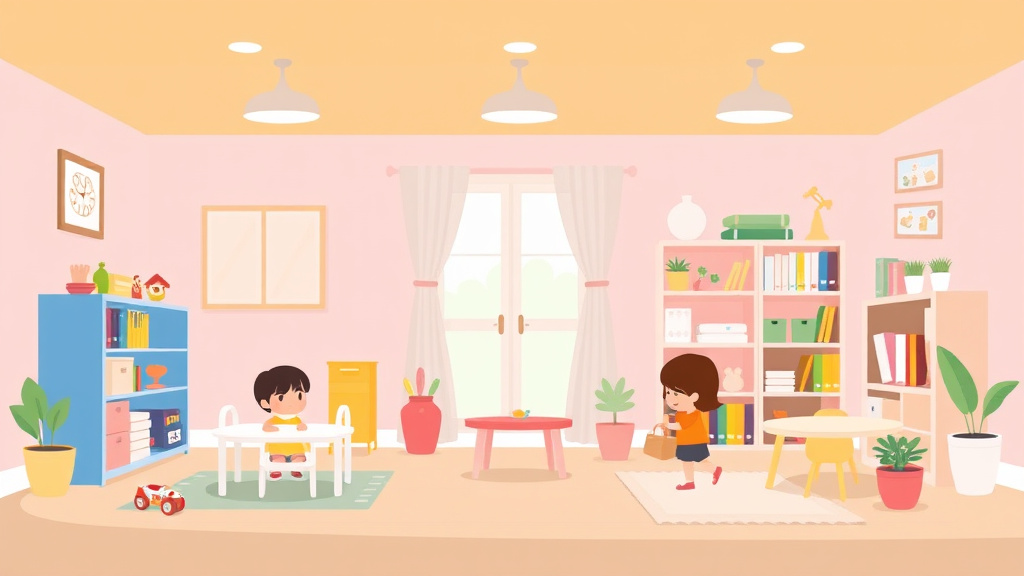
When calculating your usable space, measure only the areas where children spend time during the day. Subtract space taken up by furniture that children cannot use, such as teacher desks, file cabinets, and large storage units. Cubbies, child-sized tables, and play equipment count as usable space because children interact with them.
Your licensed capacity is directly tied to your available space. If your center has 1,500 square feet of usable indoor space and the requirement is 50 square feet per child, your maximum indoor capacity is 30 children. Exceeding this number, even temporarily, is a violation. If you want to increase your capacity, you need either more space or a license modification based on a new floor plan.
Space affects more than just your license. Crowded rooms lead to more behavioral issues, more injuries, more noise, and more stress for both children and staff. Meeting the minimum is a legal requirement. Exceeding it improves the quality of care and the working environment for your staff.
Outdoor Space Requirements
Outdoor play areas in Maryland must provide at least 70 square feet per child. Not all enrolled children need to be accommodated at once. The requirement is based on the maximum number of children using the outdoor area at any one time. If you rotate groups through the playground, you can calculate your outdoor capacity based on the largest group that will be outside at once.
| Space Type | Minimum Per Child | Notes |
|---|---|---|
| Indoor activity space | 50 sq ft | Excludes halls, kitchens, bathrooms, storage |
| Outdoor play space | 70 sq ft | Based on max children outside at once |
| Nap/rest area | 2 ft spacing between cots/cribs | Each child needs own sleeping surface |
| Diapering area | Dedicated, separate from food prep | Must have handwashing sink within reach |
| Isolation area | Separate space for ill children | Must be supervised, comfortable, clean |
Fencing and Outdoor Safety
All outdoor play areas must be enclosed with fencing at least 4 feet high. Gates must be self-closing and self-latching, with latches positioned out of children's reach. The fencing must be in good repair with no gaps, broken slats, or sharp edges. Check your fencing weekly and repair any damage immediately.
The outdoor area must be free of hazards including standing water, poisonous plants, animal waste, broken glass, and exposed tree roots. Fall zones under climbing equipment must have approved impact-absorbing surfacing such as wood chips, rubber mulch, or rubber mats, maintained at the depth recommended by the equipment manufacturer. Most equipment requires 9 to 12 inches of loose fill surfacing.
Shade must be available in the outdoor play area. This can come from trees, shade structures, canopies, or covered porches. Children should not be required to play in direct sunlight for extended periods, especially during summer months. Sun protection policies, including sunscreen application procedures, should be documented and shared with parents.
For full playground safety standards, see Playground Safety Standards for Childcare Centers.
Special Area Requirements
Beyond general activity space, Maryland requires dedicated areas for specific functions. Diapering areas must be separate from food preparation and serving areas. Handwashing sinks must be accessible to children and staff in every classroom, bathroom, and diapering area. Kitchen and food storage areas must meet health department requirements.
Nap areas require enough space for each child to have their own cot or crib with at least 2 feet of clear space on all sides. Cribs must meet current CPSC standards. Cots must be washable and stored in a way that prevents the spread of illness. Infants must always be placed on their backs to sleep, with no blankets, pillows, or soft objects in the crib.
Your center must also have an isolation area where a sick child can rest comfortably while waiting to be picked up. This area must be separate from the main activity space, supervised by staff at all times, and equipped with a cot, blankets, and access to a bathroom. The isolation area must be cleaned and sanitized after each use.
Measuring and Documenting Your Space
Before applying for a license, have your space professionally measured or do it yourself with a tape measure and floor plan. Document the square footage of each room, noting what is included and excluded from the usable space calculation. Submit this documentation with your license application.
The MSDE inspector will verify your measurements during the pre-licensing inspection. If there is a discrepancy between your submitted floor plan and the actual space, your approved capacity may be adjusted. Keep your floor plan updated any time you rearrange furniture or repurpose a room. If you add or remove a wall, add storage that reduces usable space, or change the function of a room, update your floor plan and notify the MSDE.
Consider having your space measured by a professional before applying. An architect or building inspector can provide an accurate floor plan that will hold up during the licensing inspection. This upfront investment can save time and prevent capacity disputes down the road.
For a complete guide to Maryland licensing, see Maryland Childcare Licensing Requirements: Complete Guide.
Building Compliance Into Your Daily Operations
The difference between centers that struggle with compliance and centers that handle it smoothly comes down to systems. Compliant centers do not have smarter staff or more resources. They have routines and structures that make compliance automatic rather than reactive.
Start with your morning routine. Before children arrive, the opening staff member should walk through each room and check for hazards, verify that posted items are current, confirm that cleaning supplies are locked, and check that first aid kits are stocked. This five-minute walkthrough catches problems when they are easy to fix, before children and inspectors arrive.
Throughout the day, track ratios at the top of every hour. When staff take breaks, verify that coverage is in place before they leave the room. During meal service, check that menus are posted, allergy lists are visible, and temperature logs are current. At sign-out time, verify that every child is released to an authorized person and that attendance records are completed.
At the end of each day, review any incidents that occurred and make sure they are documented. Check that medication logs are complete. Verify that the facility is clean and secure. This closing routine takes only a few minutes and ensures that nothing carries over as an unresolved issue.
Weekly, pull five to ten random child and staff files and audit them for completeness. Monthly, review fire drill logs, playground conditions, and staff training records. Quarterly, conduct a full mock inspection. This layered approach to compliance means you are always prepared, regardless of when an inspector shows up.
ChildCareComp does not provide a dashboard or a compliance routine to log into. What it provides is the $79 one-time Daycare Licensing Startup Pack (your state's requirements, an inspection prep checklist, and staff credential tracking templates in one document) and an optional $29/mo (or $199/yr) Compliance Membership that sends update notices and renewal reminders as your state's rules change.
Why Tracking Compliance Manually Fails
Many childcare directors try to manage compliance with spreadsheets, paper checklists, and calendar reminders. This works when your center is small and your team is stable. But as you grow, add staff, enroll more children, and deal with turnover, manual tracking breaks down. A forgotten renewal here, a missed training deadline there, and suddenly you are walking into an inspection with gaps you did not know existed.
The problem with manual tracking is that it depends on one person remembering everything. When that person is sick, on vacation, or simply overwhelmed with the daily demands of running a childcare center, compliance tasks get missed.
A written, organized reference solves a different part of this problem: it removes the need to research and re-derive your state's requirements from scratch. ChildCareComp's $79 one-time Daycare Licensing Startup Pack gives you your state's requirements, your inspection prep checklist, and your staff credential tracking templates in one document, so the information exists somewhere other than one person's memory. An optional $29/mo (or $199/yr) Compliance Membership keeps that document current as your state's rules change.
The cost of a violation, in fines, extra inspections, or lost enrollment, is unpredictable and can be significant, though it varies by state and severity. A $79 one-time pack, or $29/mo if you add the membership to keep it current, is a small, predictable cost by comparison.
Related Articles
- Childcare Facility Space Requirements in Alabama
- Childcare Facility Space Requirements in Alaska
- Childcare Facility Space Requirements in Arizona
Understanding Regulatory Hierarchy
Childcare licensing requirements come from multiple sources, and understanding the hierarchy helps you prioritize compliance efforts. Federal law sets certain baseline requirements, primarily through the Child Care and Development Block Grant (CCDBG) Act, which requires states to meet specific health, safety, and quality standards as a condition of receiving federal childcare funding.
State law and regulations build on the federal baseline. Your state legislature sets the statutory framework for childcare licensing, and the designated licensing agency develops detailed regulations that implement those statutes. These state-level regulations are the primary standards against which your center is inspected.
Local ordinances may add additional requirements, particularly related to zoning, building codes, fire safety, and health department standards. Your center may need permits or approvals from local agencies in addition to your state childcare license.
When requirements from different levels conflict, the most restrictive standard generally applies. If your state requires a 1:4 ratio for infants but your local ordinance requires 1:3, you must meet the 1:3 standard. This is why it is important to understand all the regulatory requirements that apply to your specific location, not just the state licensing rules.
Renewal and Continuous Compliance
Childcare licenses are not permanent. Most states require renewal every one to three years, and the renewal process involves demonstrating continued compliance with all licensing standards. This may include a renewal inspection, updated documentation, proof of current insurance, and payment of renewal fees.
Do not wait until your renewal date to prepare. If you have maintained continuous compliance throughout the license period, renewal should be straightforward. If you have accumulated violations, unresolved corrective actions, or gaps in documentation, the renewal process will be more difficult and may result in conditions placed on your renewed license.
Some states use a tiered or rated licensing system where your compliance history affects your license status. Centers with clean records may receive a higher-tier license that comes with benefits like longer renewal periods, reduced inspection frequency, or eligibility for additional funding. Centers with poor compliance records may receive a provisional or probationary license with more restrictions and oversight.
Maintain a renewal preparation checklist that you review several months before your license expires. Include all required documentation, inspections, training completions, and administrative tasks. Starting early gives you time to address any gaps before the renewal deadline. ChildCareComp tracks your license renewal timeline and alerts you to preparation tasks well in advance.
Additional Resources
These related guides may help you address connected compliance areas:
- Provisional Childcare License Requirements
- Childcare Immunization Requirements in Georgia
- First Aid Training Requirements for Childcare Workers
- Catering vs On-Site Cooking for Childcare Centers
Try our free tools
Frequently Asked Questions
What are the requirements for indoor space requirements?
The Maryland State Department of Education (MSDE) requires licensed childcare centers in Maryland to provide a minimum of 50 square feet of usable indoor activity space per child. This is the space where children actually play, eat, and learn, and does not include hallways, closets, offices, kitchens, bathrooms, or mechanical rooms.
What are the requirements for outdoor space requirements?
Outdoor play areas in Maryland must provide at least 70 square feet per child. Not all enrolled children need to be accommodated at once. The requirement is based on the maximum number of children using the outdoor area at any one time. If you rotate groups through the playground, you can calculate your outdoor capacity based on the largest group that will be outside at once.
How do I ensure proper fencing and outdoor safety for my childcare facility?
All outdoor play areas must be enclosed with fencing at least 4 feet high. Gates must be self-closing and self-latching, with latches positioned out of children's reach. The fencing must be in good repair with no gaps, broken slats, or sharp edges.
What are the requirements for special area requirements?
Beyond general activity space, Maryland requires dedicated areas for specific functions. Diapering areas must be separate from food preparation and serving areas. Handwashing sinks must be accessible to children and staff in every classroom, bathroom, and diapering area. Kitchen and food storage areas must meet health department requirements. Nap areas require enough space for each child to have their own cot or mat with 2 feet of space on all sides.
What steps should I take to measure and document the space in my childcare facility?
Before applying for a license, have your space professionally measured or do it yourself with a tape measure and floor plan. Document the square footage of each room, noting what is included and excluded from the usable space calculation. Submit this information as part of your licensing application.
Why is it important to build compliance into my childcare facility's daily operations?
The difference between centers that struggle with compliance and centers that handle it smoothly comes down to systems. Compliant centers do not have smarter staff or more resources. They have routines and structures that make compliance automatic rather than an afterthought.
Why Tracking Compliance Manually Fails?
Many childcare directors try to manage compliance with spreadsheets, paper checklists, and calendar reminders. This works when your center is small and your team is stable. But as you grow, add staff, enroll more children, and deal with turnover, manual tracking breaks down. A forgotten renewal here, a missed training deadline there, and suddenly you are walking into an inspection with gaps you didn't even know existed.